Seeing as the boat going TO Belem right before Cirio de Nazare was packed full, we kind of feared that one leaving right after would be equally busy.
As it turned out it was not. Especially on the upper passenger deck (as on the boat to Belem, cargo on the main deck, with two passenger decks above). For some reason that I don't fully comprehend, the mid decks on Brazilian riverboats are always fuller than the upper ones. A bit more shelter from sun/wind/rain? Having to carry luggage up and down fewer stairs? We (and apparently most tourists) prefer the stronger breeze and better views from higher up.
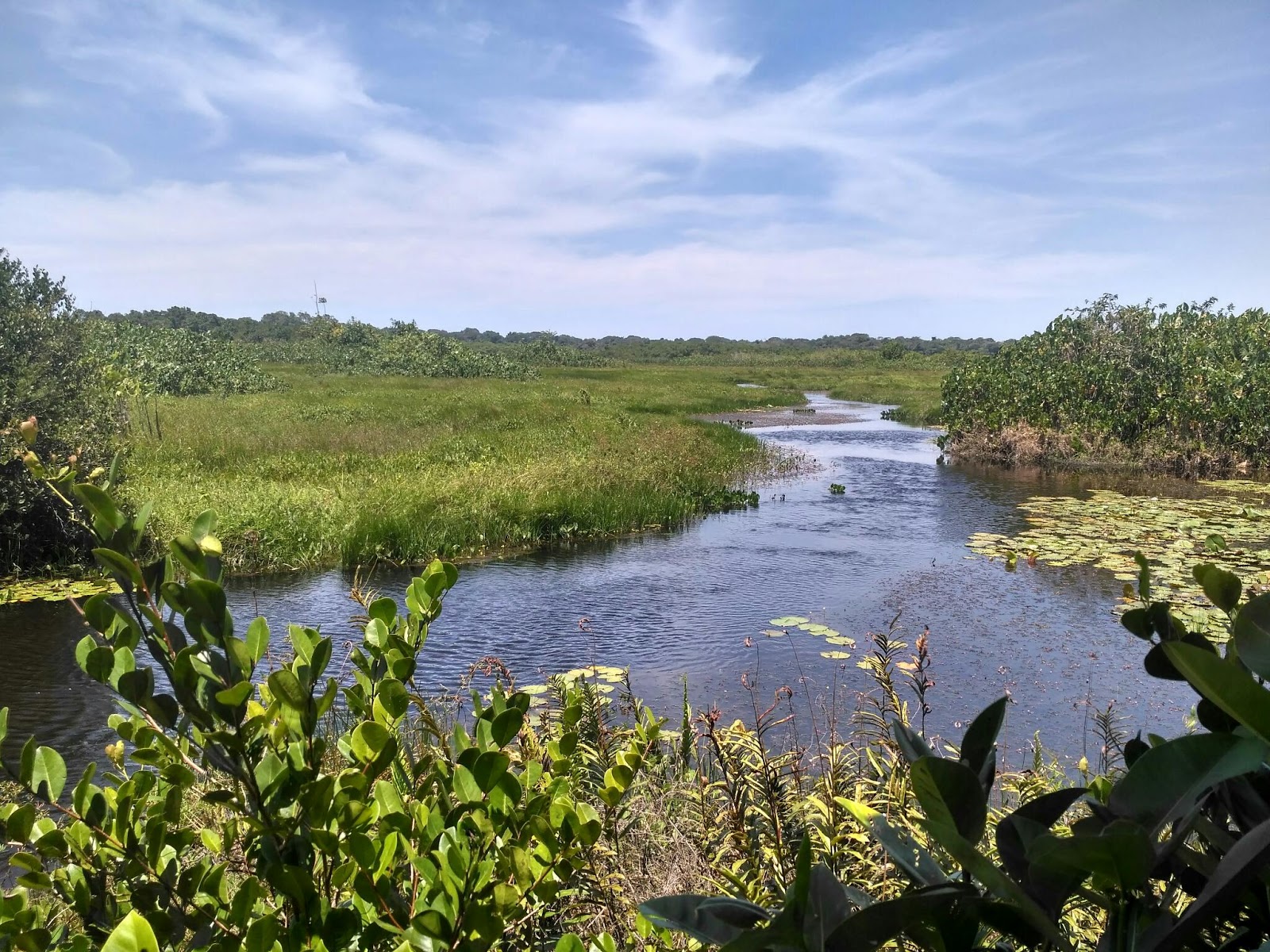
The trip from Belem to Santarem begins in a smaller channel of the Amazon, which was very reminiscent of the trip across the delta:
Thick, dark green forest right up to the banks, broken only occasionally by single wooden houses surrounded by small groves of açai palms. Even more infrequently we'd spy a little village with a church, a more substantial pier and sometimes even a school.
But by the time the first day on the water had passed, the banks were more and more frequently bare of trees with cattle or water buffalo grazing. The settlements on the riversides grew as well, and over the course of our 60 hour journey we made five or so stops at towns whose population I'd guess at between ten and fifty thousand. These places had paved streets, banks, street lighting and multi-story buildings. At each stop vendors would ply their wares. At first, keen to get the eager customers, they'd toss their goods aboard over the rail. Only later would they come aboard with their cheese, pastries, boxed lunches, coffee, juice and ice cream.
Between the vendors and the meals available for sale from the boat's cafe, you could probably survive without bringing any food aboard. But for the most part Sarah and I ate picnic lunches of cookies, passionfruit and crusty buns with cheese, veggies and hot sauce.
Later in the trip, we replaced the buns with farinha, the dried cassava flour that's eaten as a condiment in Brazil, but that we'd learned to enjoy as a staple in Guyana.
Farinha comes in finer or chunkier variations, and we'd chosen the latter as the larger chunks give a nice crunchy texture to it. Unfortunately they can also be a bit hard on the teeth.
With about twenty hours left to our destination, Sarah calmly announced that she'd broken a tooth.
Thankfully it didn't hurt, because there was nothing for it but to wait until we arrived in Santarem. The offline map on our phone (OSMAnd, which uses OpenStreetMaps data, and has been incredibly helpful on this trip so far) showed several dentists in town.
We arrived at a small dock near the centre and chose one to go look at based mostly on its proximity to the port. The office looked clean and pleasant enough, and was about to open at 08:00, so we went inside and within about twenty minutes, Sarah was the first patient of the day.
Though they had virtually no language in common, the dentist was great. Very friendly, patient and insistent that Sarah fully understood what he was proposing before he did it. This was all done using phones and translation apps, so it often took quite a while to get the meaning across.
But within two hours of arriving, Sarah had a cap on her broken molar and an appointment at 16:00 to come back and fix two other cavities that had showed up on the x-ray and caused the dentist concern. This gave us several hours to check out the city.
Santarem has a population of around 250,000, but feels (at least in the old centre) more relaxed than that. We spent most of the day lounging in parks and by the river(s). (S) because the Rio Tapajos joins the Amazon at Santarem. The fairly clear blue-green of the Tapajos appears divided sharply from the muddy brown of the Amazon as they meet and very slowly comingle. The exact location of this meeting of the waters changes, but on this day it was right in front of town, maybe 200m off the riverfront promenade.
Back at the dentist I sat in the A/C waiting area drinking coffee and waiting (I'd wondered whether a dentist's office might be an exception to the Brazilian habit of drinking their coffee intensely sugared, but no).
By 17:30 Sarah was all done and popped happily out of the office. She'd had a full set of x-rays, a cap put on her broken tooth, a cleaning and two fillings done. The cost for the lot was NZD190.
We considered spending the night in Santarem, but figured that we still had time to make it to our primary destination for this stop on our journey, Alter do Chão. We share the 60 minute, 35km city bus journey with commuters heading home, so it was a wee bit cramped but it got us to Alter by 19:30 where we were happy to find that there was plenty of room at our chosen inn.
The next morning we were up with sunrise and went out to explore our surroundings.
Alter do Chão is a town of about 7000 on the Rio Tapajos. For visitors, the highlights are its beautiful (and seemingly neverending) beaches of soft white sand.
On our first morning we waded across the narrow entrance to the Lago Verde to the white sand spit (it's not actually an island, at least not during the dry season) of Ilha do Amor. We walked up the left side of the beach, and within half an hour all signs of the town were gone. It was just us, the beach, the lagoon and some terns.
We had lunch in the central square, which is really the tourist focus of the town. One side faces the beach, one has the church and the town's only supermarket and the other two are lined with outdoor restaurants. A bit closer to the middle are two rows of small thatch-roofed stalls selling more affordable meals and snacks. Later that night we returned and sat in the square to slurp tacaca (salty-sour shrimp and veggie soup) and beers from the supermarket. On weekend evenings when it gets "busy" (which is really not very busy at all) bands would set up in the square, visitors welcome to join right in the display of local Carimbó dancing.
The next day was, if possible, even lazier. We took our hammocks out to the beach and nearest our hostel (maybe 200m), strung them between trees and spent the day there, alternating between reading, sleeping and swimming.
The water at Alter is fabulous. It's freshwater, so no need to shower salt off yourself when you've been swimming. Unlike many freshwater beaches, it doesn't have a "lake-y" smell to it. And the water is quite clear. About the only downside is the need to shuffle your way in to the water lest you step on a stingray.
As the day started to cool down I headed up the Ilha de Amor peninsula again, this time (successfully) trying to find the trail up to Serra Piroca, the small but very prominent hill that you can see from everywhere in the region. While up the too, all alone save the black vultures cruising by at eye level.
While up there I got better view of just how extensive the beaches of the region are. You could walk for kilometres along the shore in any direction and still not be close to reaching their end. Of particular interest was a long, wide beach maybe 5km north of town with a narrow arm of sand reaching right out into the Tapajos near its northern end. It had several tourist boats parked along it, confirming the (fairly obvious from just looking at it!) idea that it was worth a visit.
The next morning we set out with 5L of water, a picnic brunch and lots of sunscreen. The walk was pretty much all on beach, with a few short gravelly bits near the base of low pink cliffs and a few lightly muddy bits where it looked like vegetation was just beginning to get a foothold.
The beach at Ponta Cururu was every bit as good as it looked from the air. On one side it was very shallow. And the water was very calm and sheltered, allowing me to lay down in the water, stretched out on the sand, chin resting on my arms with no fear at all of a wave coming to dunk my head under. And unlike the previous afternoon there were few other visitors. At many times we had it all to ourselves.
There was a downside to this, however. We'd planned to stick around until it got hot then hop aboard a boat making the return journey to town. With the minimal traffic this turned out not to be possible, and we ended up walking all the way back under the early afternoon sun. There was a nice breeze, so it wasn't actually terribly hot, but so powerful was the sun that we took to stopping under trees when we could and waiting for a cloud to appear before continuing in hopes we'd make it back without being fried to a crisp.
Apparently most of the visitors to Ponta Cururu visit in the late afternoon, both to avoid this very problem. AND to check out the sunsets. Many Brazilians say that Alter do Chão has the prettiest sunsets on Earth. My mom holds that Simcoe Island (near Kingston, Ontario) still holds the title, but three out of our five evenings certainly showed that ADC is in the running. (Not that beautiful sunsets are entirely to be desired... Simcoe's sunsets benefit from being filtered through the pollution of Toronto to the west, so are Alter's filtered through smoke from burning Amazon forest).
We'd planned this to be our final day at Alter do Chão, and with the incredibly beautiful beach at Cururu and the sunset it would've made a fine finale. But the Tapajos had an even better one waiting for us.
Some of our Brazilian hostel-mates (they were all Brazilian except for a one Argentinian who was working there) had planned a full day boat trip the next day and asked if we wanted to come along. It might make getting our planned boat onwards from Santarem slightly trickier, and it did cost 100 Reais per person. But I was interested in seeing a bit more of the forest around the area, and when the possibility of seeing sloths was mentioned this turned a maybe into a How Could We Not!?
Some of our six boatmates were a bit slow getting going in the morning, so it was around 10:00 by the time we headed out of the lagoon, around Ponta Cururu and out into the Tapajos and the Amazon.
As I've noted before (and you've doubtless heard elsewhere), this river is HUGE. Where we joined the Amazon proper it looked about as wide as Lake Taupo. This wasn't quite the case, as the air at Taupo is a lot clearer, but it did mean that there were some decent waves out there, some with white water on top for us to bounce and splash our way along as we spent fifteen minutes crossing the channel to a large island out in the middle of the river.
Once there we ducked into a narrow, shallow channel that was occupied on either side by small farms (mostly cattle) and their owner's homes (up on stilts, as even in normal conditions the river would rise 3m in the wet season) and fronted by mudflats that were just starting to grow grass.
It was cool to see life on the river up a bit closer than we could from the big, intercity river boats. And at one point we were lucky enough to spot a caiman (a medium sized one, maybe 1.5m) slithering its way down into the river as we approached. This was a good omen. Caimans are usually shy and difficult to spot in the daytime.
Shortly thereafter we pulled up at the dock of one of the houses. I almost immediately feared that the sloths we were going to see were captive and/or pets as I'd just been reading about places that do exactly that.
The family running the place called it the Tralha de Preguiças (Trail of Sloths) and offered short guided walks around the forest behind their home for 20 Reais (about NZD7.50) per person. I was slightly surnoyed (I've just invented this word! It means at once surprised and annoyed!) about the entry fee on top of the boat trip. But there were no caged animals in sight, and the lady in charge seemed excited to show us around.
And was it ever worthwhile! It mightn't have felt very wild, with wide, well maintained trails crisscrossing the regenerating forest behind the home and small farm, but this was without a doubt the wildlife viewing highlight of our Amazon experience so far. We saw a greater Potoo (owl relative that looks kind of like the Australasian frogmouths, but much larger, about the size of a great horned owl. We saw yellow armed macaques (attractive little monkeys) up close. We saw hoatzin weird crested birds maybe 50cm long whose call sounds kind of like a reindeer. I'm still not 100% sure whether they're pretty or ugly, but they're distinctive. And apparently they also smell bad and the young ones have claws on their wings that allow them to climb around in the dense bush that they live amongst (I remember seeing them doing this in Ecuador some 30 years ago!)
And of course there were sloths. Four of them, including a three month old that had just left its mom. None of them were far away, but the baby in particular was only about 50cm above eye level and two or three metres into the bush. Sarah would very happily have spent an entire day just watching that one baby sloth slowly making its way around the trees, yaaaaaawwwwwning and blllliiiiiiinnnnking, both at sloth speed.
After leaving the forest and having a good long chat with the sloth lady and her family under their stilt house (most of which was lost on us as it was all in Portuguese) it was time to head back to the boat.
Back across the channel we went, returning to the blue water of the Tapajos and (yet) another beautiful remote beach. This one was backed by a few little restaurants. We'd been eyeing up the peixe assado (whole grilled fish) on the Ilha de Amor, and sharing one with a couple of our boatmates, Thays and Lourenço (on Holiday from Minas Gerias/Rio), was a perfect opportunity.
It took quite a while to prepare, during which we swam an went for walks on the beach. When it was finally ready the fish was delicious (and only slightly bony) and with all the traditional accompaniments it was a very large meal, even for four people, even with one of them being me.
After lunch we had just enough time to visit one more isolated beach before our final stop, a return visit to Ponta Cururu to watch the sunset. I'll have to admit that I initially felt like I would have rather gone somewhere else that we hadn't been before and that wasn't so busy (there were maybe 100-150 others there). But as with the Tralha de Preguiças, my hesitation proved entirely ill founded. The sunset was beautiful, we had fun swimming with our new friends. And then the dolphins appeared!
Probably close to a dozen small grey river dolphins started splashing, playing and even once or twice jumping through the water, not 50m from shore. We stood, knee deep in the water with them, almost entirely distracted from the gorgeous sunset until they decided to really show off and start playing right in front of it. Even our boat driver seemed delighted and impressed. He was just as busy smiling and photographing/filming as everyone else was!
I'm not sure how long we spent watching, grinning, pointing and gasping at them, but ours was the last boat to go and it was fully dark when we got back to the lagoon at Alter do Chão.
I'd really expected that the boat trip would have taken us to see more "wild" areas in the neighbourhood. And I was a bit annoyed at having to use the ATM in town (which charged a NZD9 "convenience" fee and gave a truly terrible exchange rate). But there were just so many amazing things about that day that even an occasional grump like me is going to be thinking back to it and smiling for a long time to come.
Alter do Chão really had seen us off in style. The next morning we caught the bus back to Santarem and headed for the Docas de Para, the main port for large passenger and cargo vessels. On the way we stopped at a convenience store to buy some farinha for the upcoming trip (the softer, finer grained kind this time!) where Sarah picked up a new pair of pink Havaianas to replace her two-year old orange pair that was coming to the end of its life.
Down at the docks we bought our tickets and went to board the boat. Not as early as on previous journeys, but still with a couple of hours before departure to allow us to get decent hammock spots. I left Sarah in charge of setting up so I could catch the end of the boarding window (in a surprisingly safety conscious move, the busy cargo port only allows passengers through at fixed times) to do a bit more shopping in town then dash back to catch the final boarding window before our noon departure.
As it turned out I needn't have worried. Noon came and went. As did 13:00. And there were still several full truckloads of tomatoes and plantains to be brought aboard for the journey to Manaus.
It was 16:00 by the time we pulled away from the pier. But we were comfortable in our hammocks and happy to be out on the water again.
The first 24 hours of the trip were similar to the end of the Belem-Manaus journey. Evidence of (if not actual) human habitation everywhere. Lots of cattle, but quite a few horses as well.
Overnight we passed the town of Óbidos where, almost 1000km upstream from its mouth, tidal effects on the Amazon are finally completely gone. Then in the morning a comparatively long stop at Parantins, home to a major annual celebration of Amazon culture. And then the people disappeared and it we were once again cruising past mile upon mile of thick forest (though this time with beaches and, at one point, beautiful bright red cliffs to add a bit of variety).
It seems that (so far at least), travelling by public riverboat up the Amazon isn't a fabulous wildlife experience. Far from it in fact. Even heading upstream when the boats stick closer to shore, the forest is either non-existent or too thick to see much. Sarah she MIGHT have seen a capybara on the shore once. But other than that our best sightings were (previously mentioned) river dolphins, a few macaws and a few ospreys.
Which is not to say it isn't enjoyable. It's kind of like long distance travel on a slow train. You get to watch the world slide by, seeing people going about their daily lives all around you. The landscape changes slowly, letting you feel more a part of it, even if you do only look up from your lazy, comfy hammock spot once in a while.
Indeed, on day two of the 44 hour trip to Manaus I commented to Sarah that this may be my new favourite mode of transportation. Which is not a bad thing because on arriving in Manaus we're still only halfway done our journey up the river.