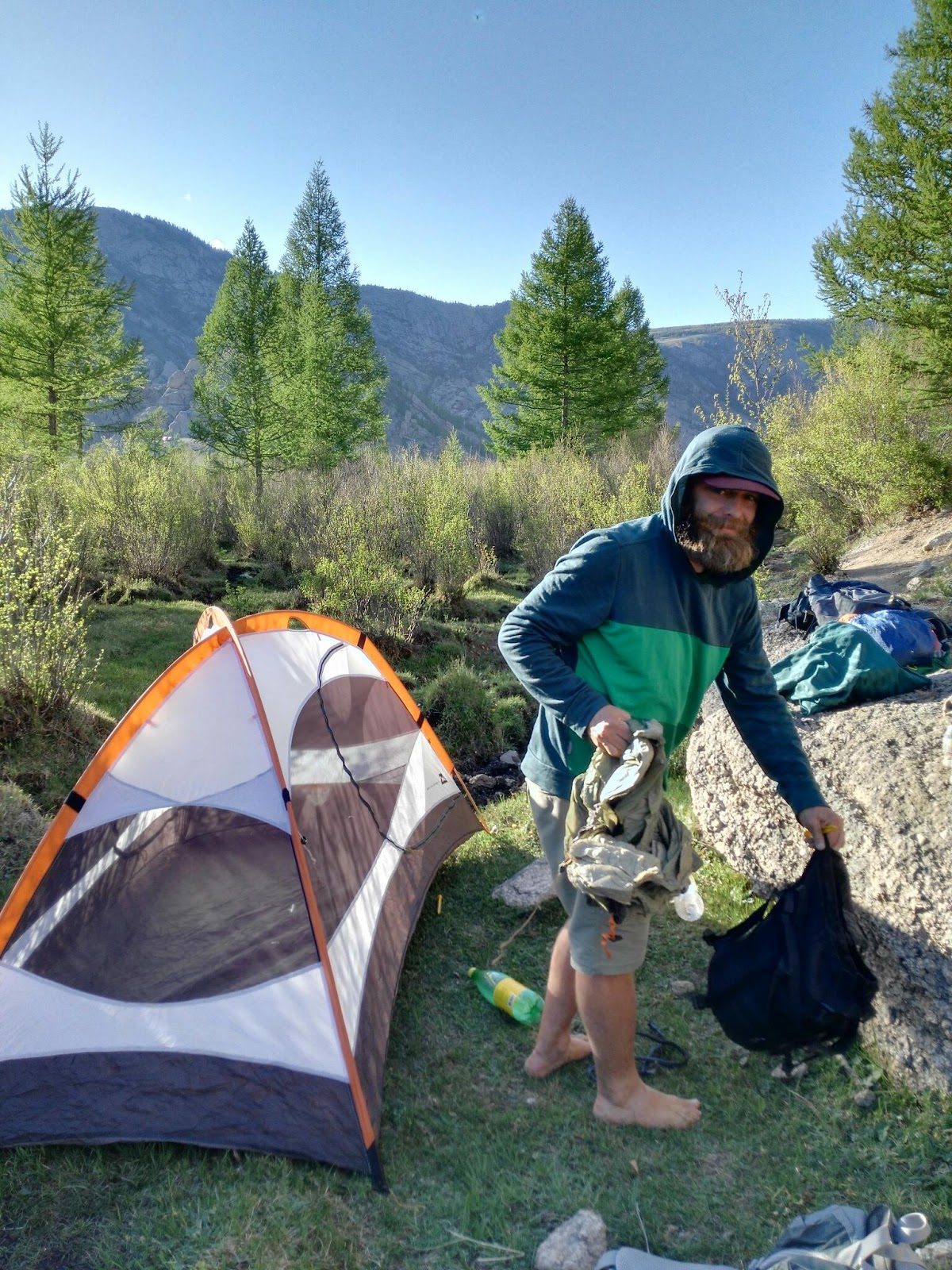
I'll begin by breaking the tension and letting you all know that, no, I didn't get a haircut. The blog title comes from something else entirely.
Following our arrival back from our tour we had a few activities planned in the big city before we headed back out into the Mongolian countryside.
I mentioned earlier that rural Mongolia isn't the place for cultural history. Ulanbataar was surprisingly well appointed in this respect.
We arrived back in town on a Friday, which meant that we could get to a show at the national Opera House, which were only on Saturdays and Sundays.
They alternate between opera and ballet, and by the luck of the draw our show was to be The Barber of Seville.
The opera house is a lovely pink-painted faux-classical building from the communist era, looking a lot like its relatives in the capitals of the former Soviet central Asian nations.
Inside, it was smaller than I'd expected, but still very nice. We'd bought the cheapest tickets, to the side up on the balcony, but as attendance was fairly low we were ushered down to seats about ten rows back in the main seating area.
I'd only ever been to two operas before, so I'm far from an expert, but I must say that I really enjoyed it. The singers were obviously good at what they were doing, as was the orchestra. And even the sets and costumes (many of which were obviously made for the performance) were well done.
It was a bit sad that the audience wasn't much more than 100 people. With a large chorus, there were probably about 30 singers, plus about 30 musicians in the orchestra. Add to these all the lighting, sound, costume folks, and all of the ushers and so on, and you were probably approaching a 1:1 ratio. And I actually did feel a bit guilty that our tickets worked out to about NZ$6.25.
For a few moments it seemed a bit odd to hear/see the Mongolian cast singing in Italian, but when their talent became apparent this was quickly dispelled and was really no odder than (e.g.) Canadians singing in Italian.
Even though the surtitles were in Mongolian, I found myself laughing right along, sometimes at the absurdities of the plot, sometimes at the entertaining acting and singing, and sometimes at my imagined versions of the words they must have been singing.
I don't think it's made me a lifelong opera fan, but I can assuredly say that if I get another chance to see a high quality performance for under ten bucks I'll be there.
The other bit of "high culture" we got during our return to UB was a trip to the national museum.
It was pretty good, with lots of interpretation in English as well as Mongolian.
Unsurprisingly, there was a big section on Chinggis and his descendant Mongol conquerors (including their siege equipment, which isn't something you really think of the horde specialising in.)
But my favourite bits were probably the 19th and 20th century traditional costumes and personal effects from the variety of ethnic groups in the country and perhaps even more surprisingly, the section on the 1989 democracy movement.
Interesting thing I learned from the museum: the foremost leader of the Mongolian democracy movement was a young man named S. Zorig. He led peaceful protests against the communist government and ensured they remained peaceful when they threatened to devolve into violence. Once the communist government fell he became a member of the legislative assembly.
A few years later, in 1998 during a hung parliament he was secretly tipped to become the new compromise prime minister, but was assassinated under strange and confusing circumstances before the announcement was made public.
Finally in 2016 three men were convicted of his murder, and almost all of the 17,000 pages of evidence relating to his death were made public. But seventy some pages remain classified and no one knows who was ultimately responsible for his murder.
On the Sunday of our return visit, Sarah was recovering from a cold (seemingly a different strain than the one I'd had) so I headed out on my own to try and catch some of Mongolia's most popular sport: wrestling.
I walked east to the National Wrestling Palace, and was pretty sure I'd found it. But the weekly meet clearly wasn't underway. Indeed, it looked like the place had been condemned.
It took a bit more searching, and taking advantage of the front desk of an international chain hotel (where I could maybe, just plausibly have been staying) but I eventually found the alternate venue quite close to home.
It was held in a repurposed basketball court, with a green, astroturf like covering over most of it. The wrestling was a bit slow, usually with many minutes of jockeying for position before one combatant would see an opening and strike, making for a few seconds of excitement which either finished the match or led to a renewal of the positioning dance.
There was, however, almost always some compelling action, as instead of a single match being contested at a time, about ten would go on at once, ocassionally spilling into eachother, or into the crowd.
Perhaps even more compelling than the wrestling itself was all the ritual surrounding it. Competitors would enter the ring flapping their arms like eagles before reporting to one of the ten referees who would remove and hold on to their coloured hat (symbolic of their rank in the pantheon of Mongolian wrestlers) before starting the match.
If it slowed down too much or was taking too long they were put into more "action inducing" positions by the refs. This happened multiple times in one crowd-favourite match involving a wrestler not too much bigger than me (but obviously a lot stronger) versus a guy who was much bigger indeed. The big guy did eventually win (there are no weight classes in Mongolian wrestling) but the smaller one's tenacious defence had made him a crowd favourite in the meantime.
At the end of the match one wrestler (not always the winner as far as I could see/ would duck under the other's arm, then the winner would present himself to the crowd, once again doing the eagle flapping dance, before finally being gifted some small victory prizes, which were usually tossed to the clamouring crowd.
On the Monday after wrestling, our plan was to take a bus out to Gorkhi-Terelj National Park, 70km from UB. Best laid plans...
I went to pick up our train tickets for our Thursday train out of UB, and scouted out the bus stop on the way.
I'd been told it left from near the Naran Tuul Hotel, so I popped in there and asked the front desk if they could show me exactly where the bus left from. "Oh, very nearby!" they said, "just 200m down the street, across from that yellow building there at the MaxMall."
Perfect. We were all set. Sarah and I got to the place, found a bus sitting outside, with the driver talking on the phone in his seat, presumably waiting for our 16:00 departure. I was a bit concerned when after waiting 40 minutes, 15:45 came and went with no other passengers appearing. But supposedly the park was mostly a summer and weekend destination for UBers, so maybe it was just a quiet day.
When the driver got off the phone at 16:05 and descended we asked if he was headed to Terelj. Definitely not. I'm still curious as to why he spent an hour sitting in the driver's seat of an immobile bus talking on the phone.
Anyhow, it was back to the Sunpath hostel for us. In the end, this wasn't a terrible thing as:
A. It allowed me to have a final dinner with our tour-mates Ben and Kathryn before they caught the train north to Russia.
B. It allowed Sarah to rest in bed all afternoon and evening to work on defeating her cold and;
C. On our walk back it became bitterly cold and started snowing, with some of it remaining on car roofs until early the next morning.
The next day we tried again with a bit more information and, this time, succeeded. It took about an hour to be fully out of UB, then another to get to the entrance to the National Park.
In NZ, and even more so in Canada, national parks are natural places of such importance and beauty that development must be limited. Gorkhi-Terelj appeared to be a natural place of such beauty that infrastructure for visitors must be maximised to ensure that everyone gets to enjoy it. The main road through the park was one of the best we'd driven in Mongolia, and was lined on both sides by tourist ger camps and hotels.
Just north of the park's northern boundary, the town of Terelj was the final stop for the bus. There were plenty of holiday gers there too, but many of these seemed to be the holiday homes of UB residents.
We'd originally planned to walk up a valley to the north of the park, but the missed bus of the previous day limited what we could do there, so we had a good look at the Open Street Maps map and contour lines of the National Park and decided to camp at its northern edge, then head back into it the next morning. This involved an hour or so's walk, plus some very chilly feet from two stream crossings before we got to our campsite.
It was a windy night, and our tent fluttered and flapped a bit noisily. And the area we were camping in, while only 4km from Terelj, was just wild enough that we could be irrationally worried about bears and/or wolves.
Between these two factors I didn't sleep super well overnight, but managed to get a good sleep in the following morning.
This wasn't really a big deal, as we had only about 13km to walk on our hike that day, and daylight that lasted until after 21:30.
The day's walk was a nice mix. We started with a short walk up a small valley clearly visited infrequently except by goat and sheep herders. Then up and over a low mountain saddle that was the closest thing we saw to a truly wild part of the park. Then down to the main road before taking a short but very pretty stroll through the back woods and hills between two ger camps. And finally ending at the park's most popular spot, Turtle Rock.
It was still pretty quiet as the resorts in the Turtle Rock side valley were mostly still gearing up for the summer season. But at least a couple of shops were open so we could buy some soft drinks, water (both of the streams we'd planned to filter water from turned out to be dry), and a beer with a camel on the can for Sarah.
At Turtle Rock itself, we were joined by a couple of small tour groups, some guys offering camels and horse rides and a group of three women conducting shamanic rituals at the base of the historical formation.
But come 18:30 or so, it was pretty much just us as we set our tent up in the shadow of the turtle.
It was a much calmer night, but we still woke up early, partly due to an early bedtime, partly due to the 04:30 sunrise, and partly due to the camels that came to visit not long after.
Camels with sunrise, then yaks out the bus window on the way back. This was very much Sarah's kind of morning.
Back in UB it was a beautiful warm and sunny day. It seemed summer (or at least late spring) had arrived at last. We had enough time to haveva shower, send some postcards, do a bit of souvenir shopping, prepare our train snacks and say farewell to our hosts at Sunpath before heading to the station for our 17:20 departure back to Zamyn-Üüd and the Chinese border.
Near the station we had one final Mongolian meal (meat dumpling soup with meat and creamy grated carrot salad.)
The train trip was just as pleasant as we'd remembered it. We had pleasant smiles and snack exchanges with the ladies across from us, played around with a two year old and her one year old sister, drank lots of tea (Mongolian Railway Brand! Nice Wagon. Prefer favourable Relationships!) and finished off with a bottle of Toop (our own cocktail of peach [pronounced Toor in Mongolian, but spelled Toop in Cyrillic] Fanta and vodka. Really, it's better than it sounds. Or at least greater than the sum of its parts.)
With our arrival in Zamyn-Üüd our time in Mongolia was almost at an end.
Especially with us finding our feet after the tour and doing some independent travel, I'd really enjoyed it. Lots of cute animals. Beautiful huge landscapes. Cozy gers. Fun and friendly nomadic families. Food that was... well, better than I'd feared anyway.
Despite my excitement to be returning to China, I expect I'll look back fondly on Mongolia's charms.
A few random bits of Mongolia that I'd forgotten to mention until now:
It was common to see basketball backboards and hoops all alone out in the grasslands. Nomad families would set them up and move on, leaving them and little else in place in anticipation of returning the following year.
Hybrid cars were everywhere! Maybe even 1/3 of the cars in UB were Priuses, and it was common to see them bouncing along the rutted dirt tracks in the grasslands.
During the communist era, the Mongolian government gave out medals like the typical Soviet "Labour Hero" ones. They also have out ones for heroes of literacy (there may have been lots wrong with the Mongolian communists, but they did raise literacy from under thirty percent to almost 98% in about 3 generations) and, even better, champion herder awards and People's Herding Hero medals.
Whenever a Mongolian accidentally steps on someone else's toes, they immediately shake hands, even if they're otherwise complete strangers.
That'll do as a fun farewell to Mongolia. See you next time on the other side of the border!