Chengdu was one of my favourite cities in China during our 2012 trip, and I was looking forward to the return visit.
It didn't disappoint. Accommodation was a minor difficulty as 20 minutes after making our room booking on Chinese website ctrip, we got a call from them telling us that the hotel we'd booked (on their English website) couldn't accept foreign guests (this wasn't the first time this had happened). But credit to ctrip, they offered us a private room in a very nice Blossomy Youth Hostel nearby, which was definitely nicer, and offered to pay the price difference.
The hostel was very near to Wenshu Buddhist temple, one of our favourite spots in the city, partly for its architecture and atmosphere, and partly for its ornamental pools jam packed with turtles. There weren't nearly as many this time (probably the better for the turtles), but it was still lovely to sit by the ponds or in the prayer courtyards thick with incense smoke, smelling lovely and keeping the mosquitoes at bay.
We also had some super-flavoursome dumplings and peppers with very firm soy protein at the vegetarian restaurant attached to the temple.
This gave us relatively little time for talking with our host at the hostel, Susan, before dinner. Probably my favourite thing about Chengdu and Sichuan generally was the spicy, fragrant, glorious food. Our first full meal back was at a busy corner restaurant where you picked fresh ingredients from a fridge, piled them on a tray and presented them to the owners who would cook them up in broth, further season them with flavoured oils, herbs and spices and present them to you as a mini-hot-pot/giant communal bowl of soup.
I've long said that there's a time and place for every beer, and this was absolutely the right time and place for the cold, mild (under other circumstances you might say insipid, but not now), 3.3%abv rice adjunct lagers that China produces in abundance. Plus another 2.5 bottles apiece in front of a little corner store on the next block over, whose owner delighted in having our custom and company.
Having done all of the "must dos" in Chengdu (pandas, etc.) the first time around we could skip over them this time and just devote ourselves to having a pleasant time. This we did on day 2. In the morning we saw to getting my phone fixed (it was originally imported from China, so parts were cheaper and actually existed in Chengdu, unlike in NZ.) While that was being done we hung out in the main square (mistaking the unimpressive fountain and music show for a warm-up). And we checked out the very impressive (and fabulously designed) traditional shadow puppetry/puppetry exhibition on the top floor of the museum on the west side of the square.
Pretty much the whole afternoon was spent visiting the lovely cool, green People's Park and sitting in a tea garden at its centre. We had a long conversation with Ricky, a local guy who spoke excellent English and was heading to Toronto and Montreal in a month. We played cribbage (harkening back to our 2008 trip through the Middle East and Indian Subcontinent). We sipped at and endlessly topped up our cups of Jasmine tea.
On the way home we stopped and had more awesome food (Mapo Tofu and Eggplant With Fish Flavour) on the restaurant street adjacent to the hotel we stayed at with my mom in 2012.
Our final day in Chengdu we headed to the northern suburbs in the rain to check out the wholesale markets (want ten dozen pink straw hats? Eight cases of blue highlighters? Children's rides for outside your supermarket? You've come to the right place). We were near the train station, so we picked up our tickets for the next day while we were at it.
Another afternoon, another tea garden (an indoor one this time) and another day of mildly overdoing it on the food. We (mostly me) snacked on spicy fried potatoes before returning to our first night's spot for dinner. I think this may be the best value food in a country that's full of it. If you forgo the meat, ingredients are under $5/kilo, so a big dinner for two including rice, a 500ml beer and a 600ml Sprite (for radlers naturally!) came to RMB28 (NZ$6.15) split exactly half and half between food and drink.
Apparently there's a Chinese saying about Chengdu, which says something along the lines of "don't go to Chengdu while you're young," the idea being that it's such a pleasant and relaxing place that if you do you'll never get anything done with your life. I see what they mean, and don't mind the idea at all.
The day of our departure from Chengdu was a bit of an adventure, partly according to plan, partly not.
The adventure that we'd counted on went very smoothly. A train to the city of Hechuan, just over the Sichuan provincial border in the independent municipality of Chongqing (when we'd mentioned to Ricky in the tea garden that we were going there he'd seemed surprised that the trains would even stop there. When we arrived it appeared to be a city bigger than Wellington. China!) Once in Hechuan we needed to get from the train station to the north bus station. No problem, a local bus leaving from the train station terminated there. Then we wanted a less-local bus to the town of Laitan about 50km away. Again, no problem, there was one leaving in 40 minutes.
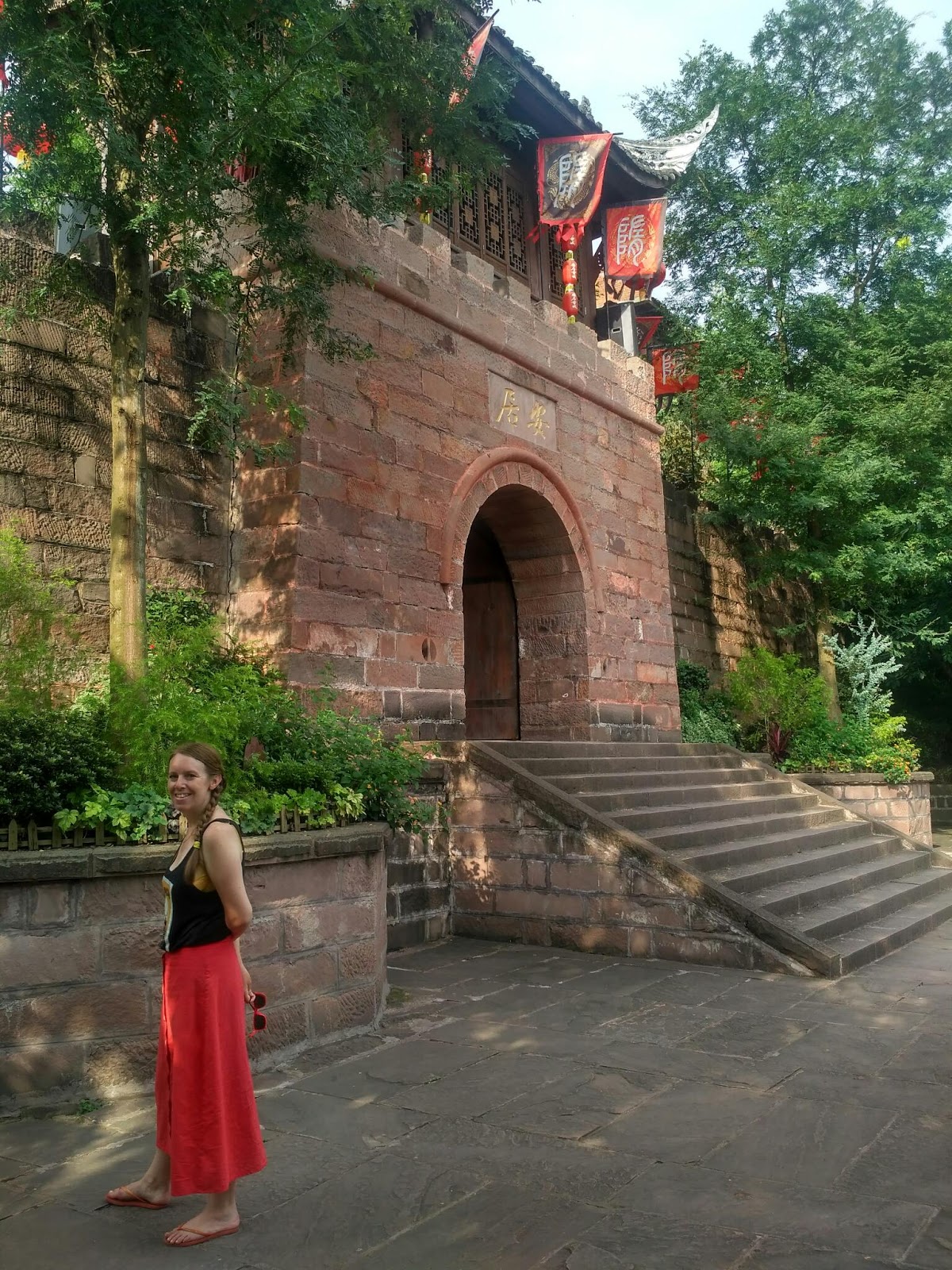
On arriving in Laitan we walked down the main drag and through the lovely unrestored gate into the old town. We weren't that enthralled with the place, as both of the two major streets (and there were really only two major and two minor ones) were packed with tourist restaurants and souvenir shops. And of the two hotels inside the walls, one was closed and one wanted nothing to do with foreign guests.
Sarah sat in an (admittedly pretty) walled courtyard-garden getting savaged by mozzies while I went back to the bus stop to see when the next bus back to Hechuan was, only to see the last of the day pulling away.
Luckily I found a nice and modestly priced hotel just outside the town walls (I think it was the only other accommodation in town) so we could enjoy our evening in Laitan.
Without the grey-tinted glasses, it was actually a pretty nice place. We wandered around the outside of the walls and discovered a pathway descending into a bright green valley that was crisscrossed by ancient-looking stone walkways and seemed to be a giant natural bamboo and rock garden. Back in town we were in a better mood to appreciate the place especially once the locals started to shut down their tourist shops and head out into the narrow cobbled streets to dance, play cards or chat with their neighbours.
Dinner was a couple of Sichuan staples. They were surprisingly bland, but when combined with the pickled garlic and fermented-soy-bean/chili/peanut paste that the town seemed to specialise in they were very tasty.
The next day in the backwaters of Chongqing was similar to the first, but moreso.
Back at the Hechuan north bus station we found the city bus that headed to the south station (I'd figured out which number it was the previous day) and at the south station collected a couple of tickets to another old town, Anju just back across the border in Sichuan.
The ticket said 17:30. It seemed improbable that the next bus wasn't until then, as Anju is a decent sized town, only about 35km from Hechuan and it was just after noon. The lady at the counter had tried very hard (but failed) to get us to understand something when she sold us the ticket, so we figured we'd go out and sit by the buses and hope someone would direct us to one headed partway there or some such. As it turned out, an Anju bound bus appeared in about 15 minutes and soon after we were on the road.
The ride was very pretty, through subtropical hills filled with small villages rice terraces (and construction for a new, larger road.)
Like Laitan, our first impressions of Anju were mixed. The area near the bus "station" (dirt parking lot really) was rough looking, but appeared genuinely old and truly lived in. Elsewhere the buildings were all new 5-6 story ones in Ye Olde China style, with significant construction work going on along the creek at their centre to build even more of them, and bigger.
We found a hotel, but there seemed to be no one around. A young woman (with a memorably pretty voice) appeared, did some phoning around and eventually, after a positive start, made it clear that we couldn't stay there.
She kindly took us to another hotel, this along a clearly older, but heavily restored, street that paralleled the large river that Anju sat beside.
It was a very nice looking place. Indeed, too nice for us. I explained this to the staff, telling them that the 288RMB for the standard room wasn't in our budget.
We walked all through the town of 50,000 or so, asking at every hotel if they had any rooms available today. The invariable answer was "No," with an implied "not for Laowai (foreigners)". In a couple of places someone at the desk would say yes to us, then call a manager to sort out the price or how to check us in, at which point, yes turned back into no.
We were about ready to give up and head back to Hechuan (where we'd observed it might be fun to spend a night anyway), leaving Anju and its Disneyfied streets and Not-For-Laowai hotels behind. Then we were welcomed into a very pleasant, inexpensive, air conditioned hotel by the friendly mustachioed proprietor.
Whew!
As with Laitan, having found a home for the night and getting our (admittedly not that heavy) packs off our backs put us in a better frame of mind to appreciate the old town.
Anju was founded way back in 588, though most of the present old town is 16th-19th century Ming and Qing dynasty.
We spent a couple of hours walking around the three or so "ancient streets." They were clearly all done up for tourists, but at 16:00 on a Wednesday in June there really weren't many there other than us. The town was very pretty, especially the (closed) guild halls, and the fire god temple (constructed on the remains of a government building that burned down.)
We went back to our hotel then went out for a tasty, friendly Sichuan cuisine dinner and headed home around 20:30, with the sun firmly down and even the newer parts of town looking very pretty with their decorative lights on.
We'd made it up about three stairs on our return when a woman came running after us, making a lot of noise. We couldn't make out exactly what she was saying, but the general idea was clearly "you can't stay here!" I can just imagine her getting home and her husband saying "oh, by the way, I gave a room to a couple of Laowai this afternoon," and her replying "you did WHAT!?"
The friendly husband with the mustache reappeared, handing us the money we'd paid earlier.
Protesting in English and terrible Chinese didn't help. Stepping behind the front desk computer and clicking over to the tab on their registration system that allowed them to register foreigners didn't help.
Short of staging a sit-in, it was clear that we wouldn't be residing there that night. Apparently some (powerful) local authority in Anju had decreed that it wouldn't be so.
When we finally collected our bags and stepped out into the street our erstwhile hosts were very, very apologetic, but also clearly relieved. It was a very difficult spot for us to be in, but presumably it was for them too; kick out the guests you'd already accepted after dark, or risk (I'm guessing here) a major fine or worse.
Out on the street we wondered what to do. Buses back to Hechuan would have stopped running. We had a tent, maybe we could try camping somewhere? Worst case would be sleeping on the streets, but it was warm, and almost certainly safe.
Just then a little police golf cart with three officers aboard happened by. We flagged it down, planning to try and explain our predicament. Thankfully we didn't have to as our host from the hotel appeared and did it for us.
Two of the cops climbed out, the hotel guy climbed in, and we went for a ride. We'd no idea where we were going. A hotel that could accept us? A bus or taxi stand? As it turned out we drove to a nearby police station. The officer knocked on the door, talked for a bit, and then we set off back the way we'd come. We slowed by our hotel. Would we be allowed to stay there after all?
Nope. Just dropping the proprietor off.
Then again down the road into the night.
Eventually we realised where we were headed. Back to the nice, but pricey lodgings we'd seen earlier, which were apparently the one place in town we'd be allowed to sleep. The officer dropped us off at the end of a pedestrian ancient street, and pointed us in the direction we knew we'd be pointed in.
At that point it seemed we were pretty much out of options, so we decided to pay up and sleep in a bed for the night
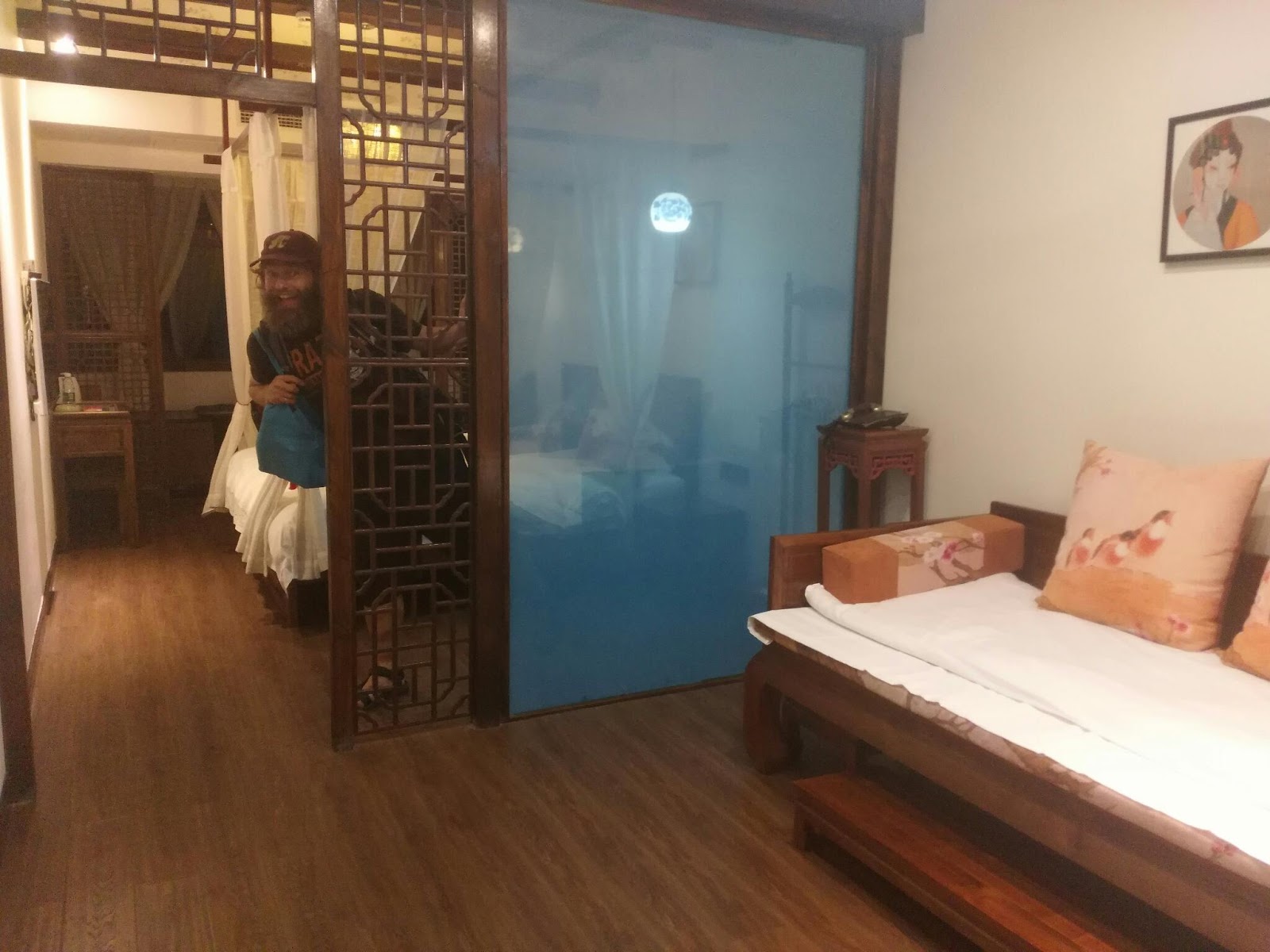
The place really was very nice, and our "standard room" was really a suite, complete with sitting room, 4-poster bed, tea-nook overlooking the river, and a bathtub with a similar view.
For the NZ$65 price it actually was very good value. It was still out of our regular budget, three times what we normally paid, but it'd be a great place for a splurge night. I just wished we'd got into our room before 21:30. And not been forced into the decision, whether by corruption (the police superintendent's cousin owns the fancy hotel) or misguided kindness (the mayor wants to make sure that foreigners in his town see only the First-Class accommodation).
The next morning and early afternoon were spent enjoying our fancy digs to the fullest (I had a bath, of course). Hotels in China often have checkout times of 11 or 12, and when we arrived I'd asked if we could stay til 13:00, which the staff were okay with.
One more stroll back through the ancient streets and it was time for the bus back to Hechuan.
Tasty, spicy noodle lunch and a walk through a food market, then on to the train station.
We arrived with about an hour to buy our tickets for our one and only high-speed train trip in China. This was more just for the experience than to save time, but be that as it may, service D5144 zipped us to Chongqing's North Station in a mere 25 minutes at an average of about 195km/h.