Showing posts with label Morocco. Show all posts

Friday, 5 April 2019

Little and Big Marrakeches, Hanging With the Whanau in Essaouira

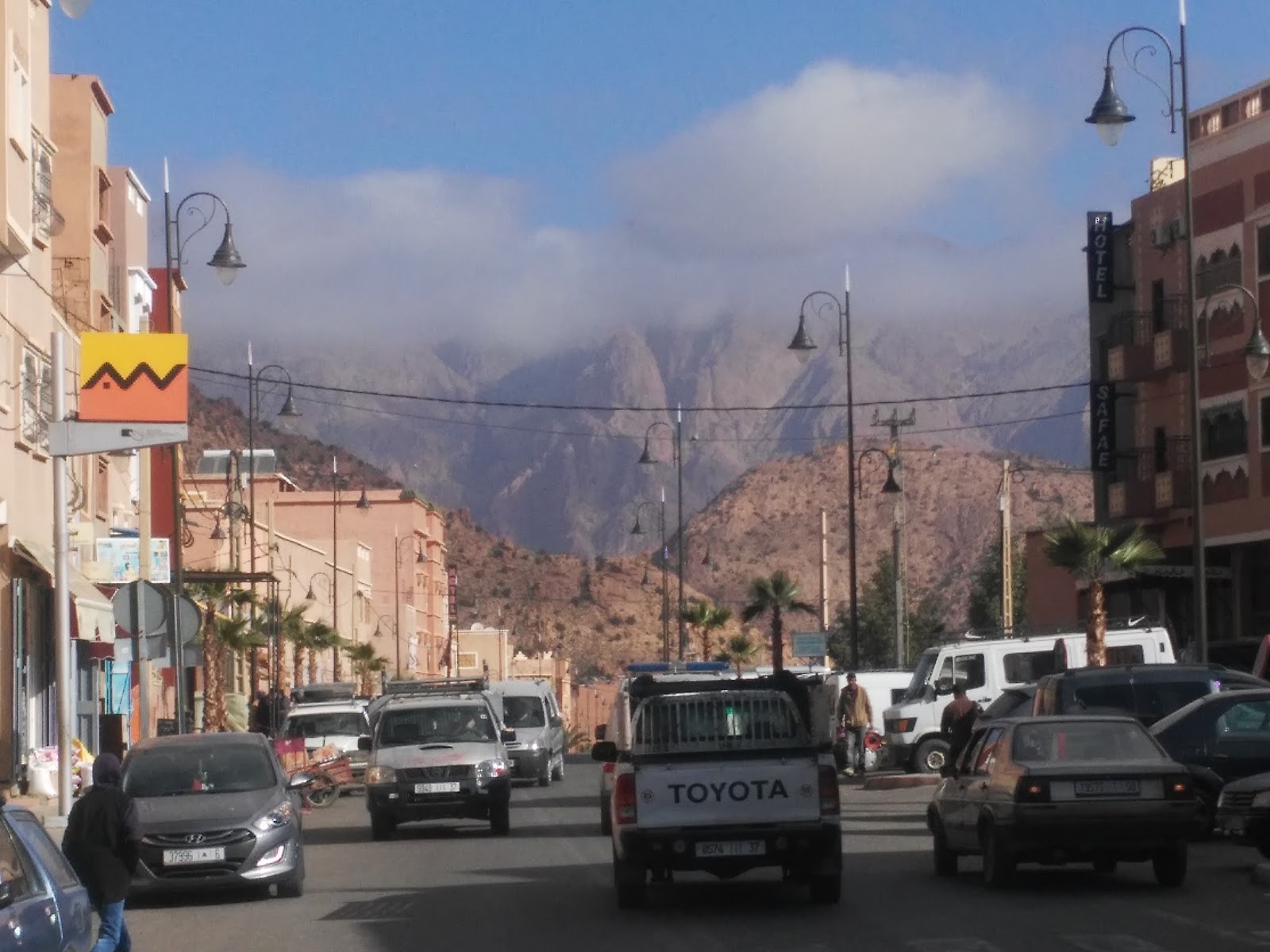
Taroudannt is sometimes called Little Marrakech.  And while we hadn't been to it's big brother city yet, we thought that a visit to Taroudannt might give us some idea of what all the fuss was about without all of the, well, fuss and hassles that purportedly go with a visit to Marrakech.

We spent quite a bit of our two days there just wandering around or sitting up on the balcony outside our hotel room.

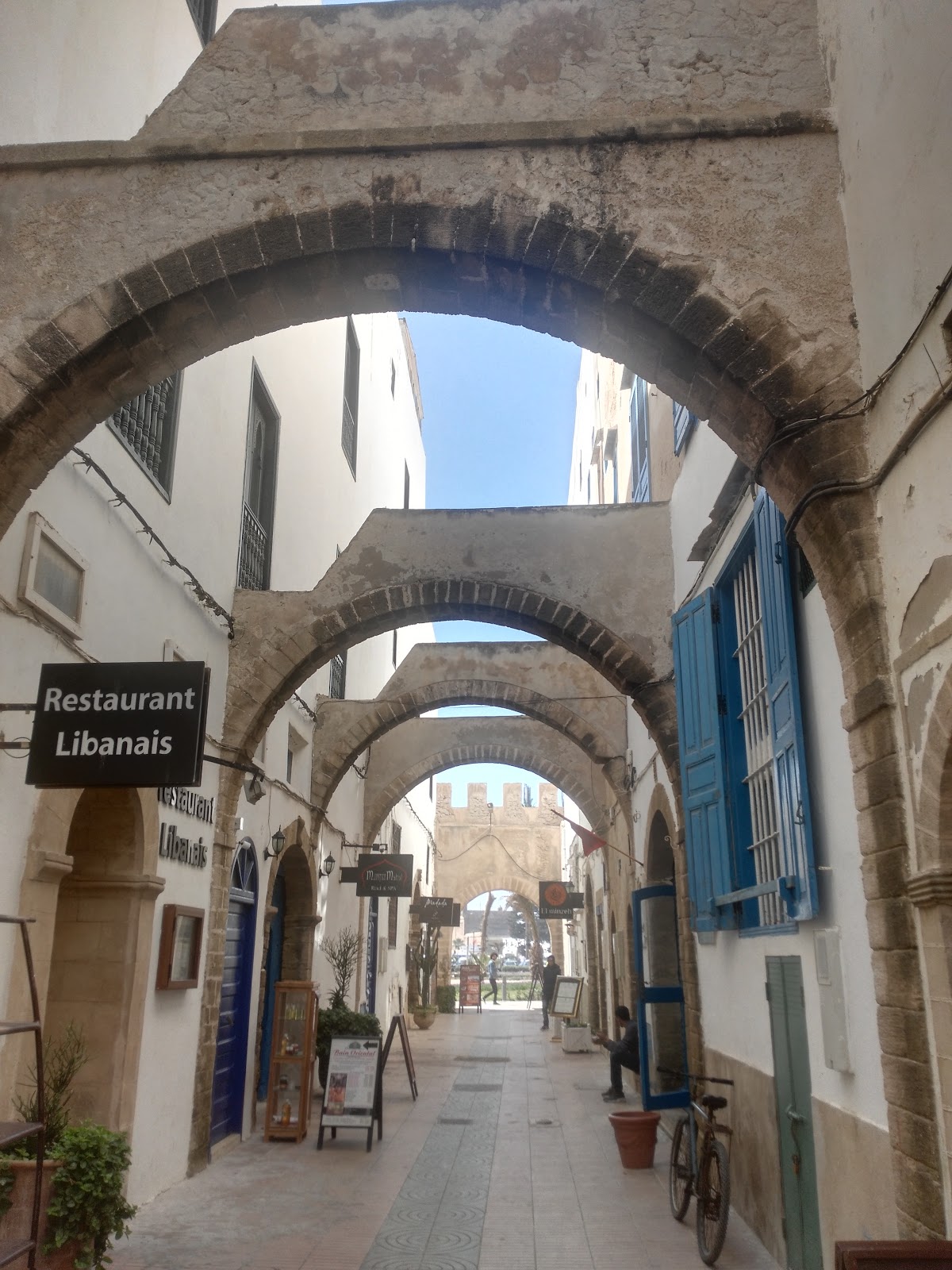
The wandering was mostly around the ancient city walls and the newer town inside them. Moulay Ismail (of Meknes fame, one of the more moderN if not moderATE) sultans, destroyed the entire town in 1687 in retaliation for its residents having resisted his rise to power, but he left the thirteenth century walls and gates standing.


It was very nice to just spend some time in a Moroccan city that was largely (though not entirely) unaffected by tourism.  (In the souq we did end up getting badgered into buying a pair of shoes that we were kind of interested in, but would really have liked more time to comparison shop for.  Upon reflection I really wish we'd just told the guy that his pushy attitude had lost him our business. But I guess the proof is in the pudding that at least sometimes being pushy is the way to make a sale).



We also had an absolutely, 100% untouristy visit to a local hammam (public baths).  We'd spotted one during our wanderings through the Medina and returned there in the evening, complete with a couple of small tubs filled with savon beldi, traditional semi-solid Moroccan olive oil soap that looks like nothing more than thick axle grease.  We went in our separate entrances to warm, tiled rooms where we each waited around, hoping for someone else to come in and demonstrate the correct procedures, etiquette and even attire for the place. In the men's section you kept your underwear on while bathing (glad I brought a spare pair!) and with my black cotton briefs on I was still the least modestly attired of the half dozen guys in the bath, several of whom were wearing full on swim trunks. In the next room, which was warm and steamy enough to qualify as a cool-ish sauna, I was largely ignored by the other bathers as we filled our buckets (provided by the hamam) with water mixed from the cool tap or the scalding hot tap, and lathered up with beldi soap.  You'd then sit and sweat, letting the pores open up to admit the olive-scented beldi before rinsing off, perhaps followed by a quick visit to a small private stall to wash the bits covered by your swimsuit or undies. Then it was back to the first room to dry and re-clothe (again done very modestly, using strategically placed towels so no two men ever saw one another nude, even for a moment). Apparently it's also common to have a good exfoliating scrub with a camel hair brush, administered by either a friend or a hammam employee, but I didn't see anyone getting the treatment during my visit.

Another fun cultural experience was sitting sipping coffees on the main square, watching crowds of Moroccans surrounding traditional storytellers and musicians for their afternoon entertainment.  Nearby the square we also attempted to post the aforementioned shoes. From the outside the Moroccan post offices look pretty slick and modern, so I'd thought this would be straightforward. However on saying we weren't just there to buy stamps, we ended up filling out a form and sitting in a waiting room with a bunch of Moroccan clients for twenty minutes before we just gave up and left.


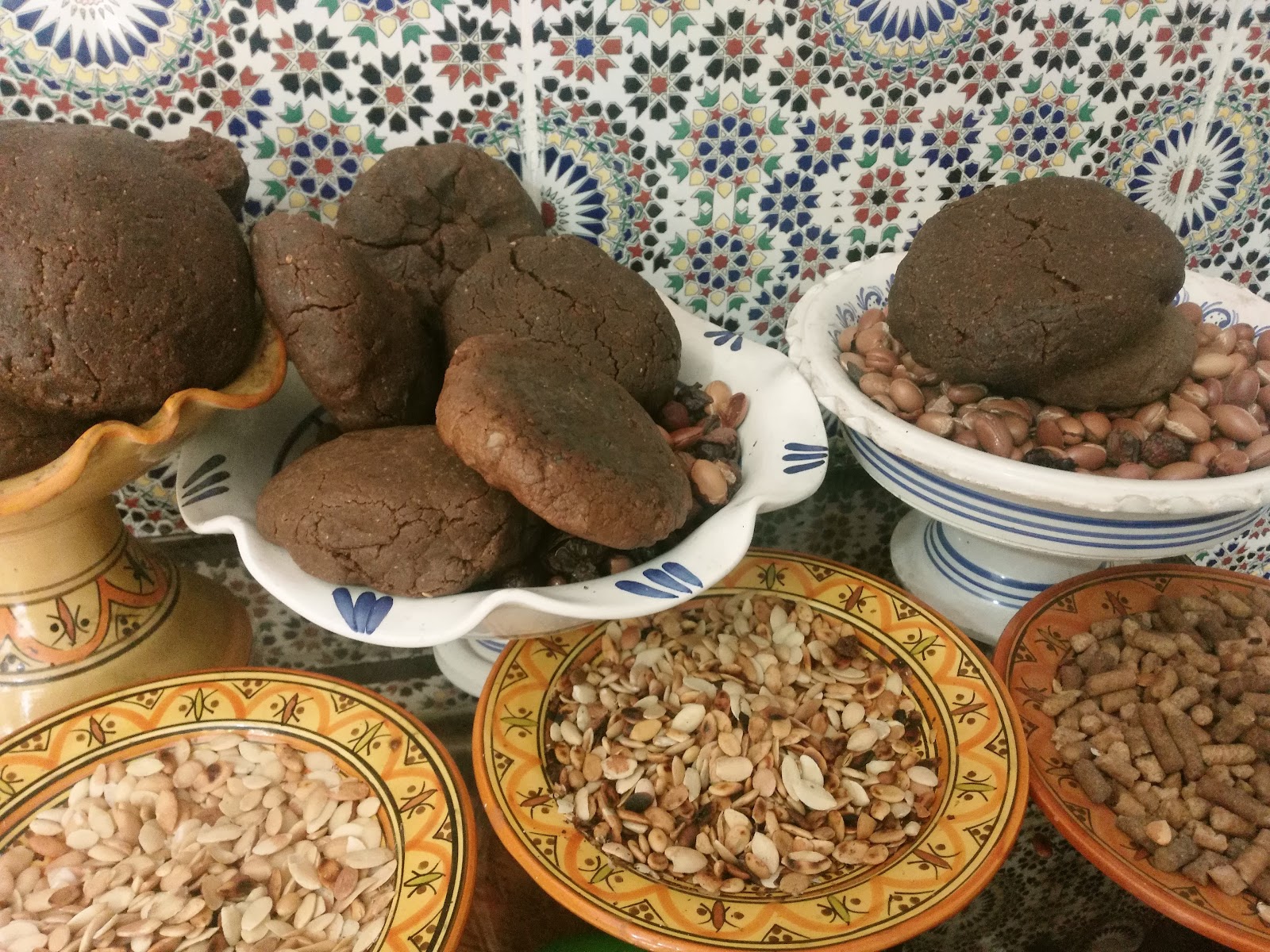
In another turn of disorganisation, we went for a coffee at a fancy hotel.  The double-normal pricetag for the drinks, paid at the front desk as you entered was effectively an admission fee to its grounds, in a seventeenth century palace.  However it turned out that there was no coffee available (in a country where every third building in commercial areas is a cafĂ©!) But the palace itself was (both figuratively and literally) cool, so it was nice to sit and sip our orange juices in its gardens while the sun baked the walls outside in (hot for early March, if not for Taroudannt generally) 31 degree heat.

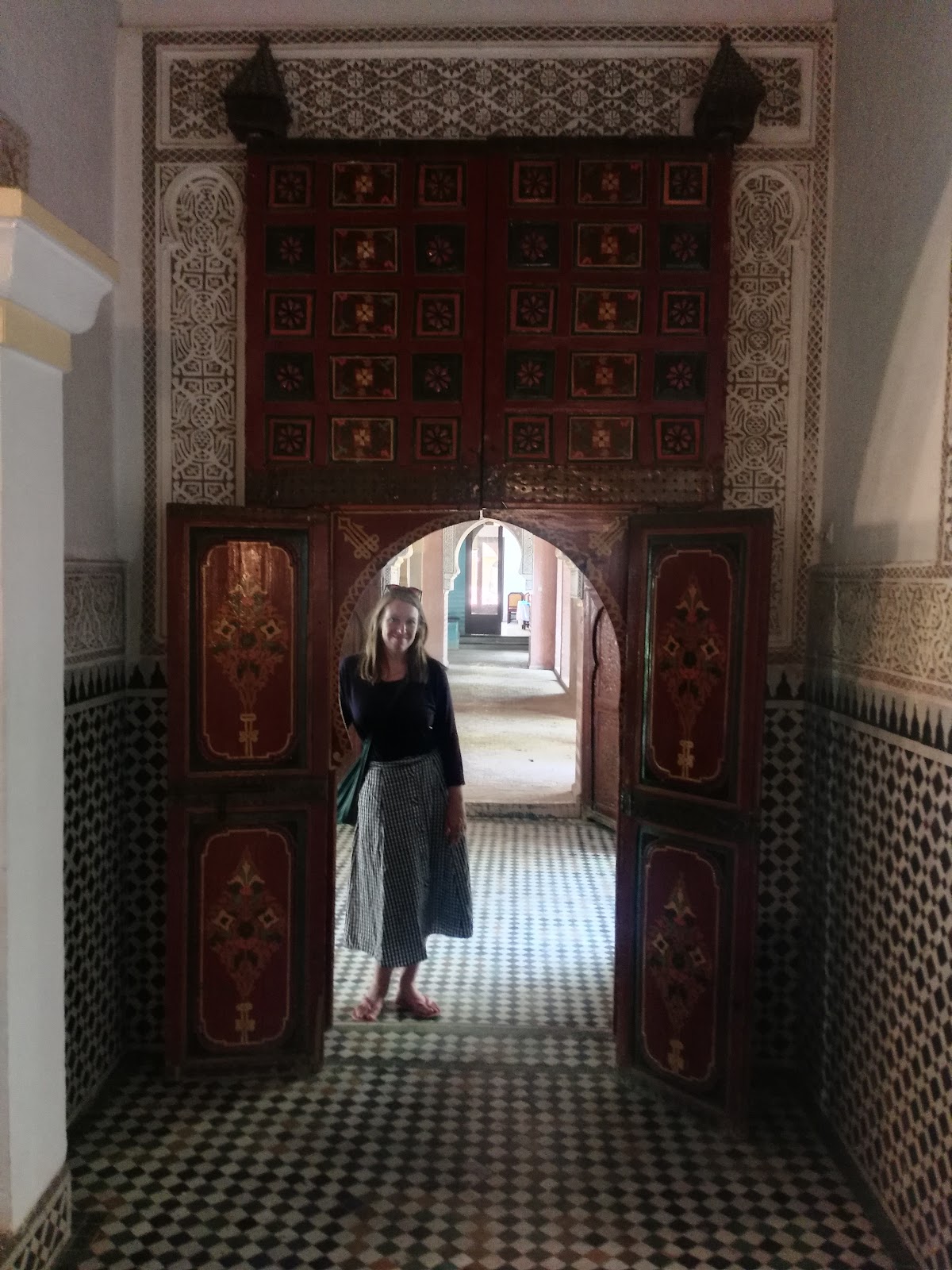

Speaking of oranges, while we'd recently learned to love Moroccan orange juice, we actually purchased our first Moroccan oranges (mandarins actually) in Taroudannt.  And while they may or may not have included the best individual mandarin I've ever eaten, they were definitely the best kilo of mandarins I've ever had. And they cost less than NZD 0.30!  After we finished the first kilo with our dinner of bread, olives and fresh hot peppers I felt compelled to go out and buy a second one!
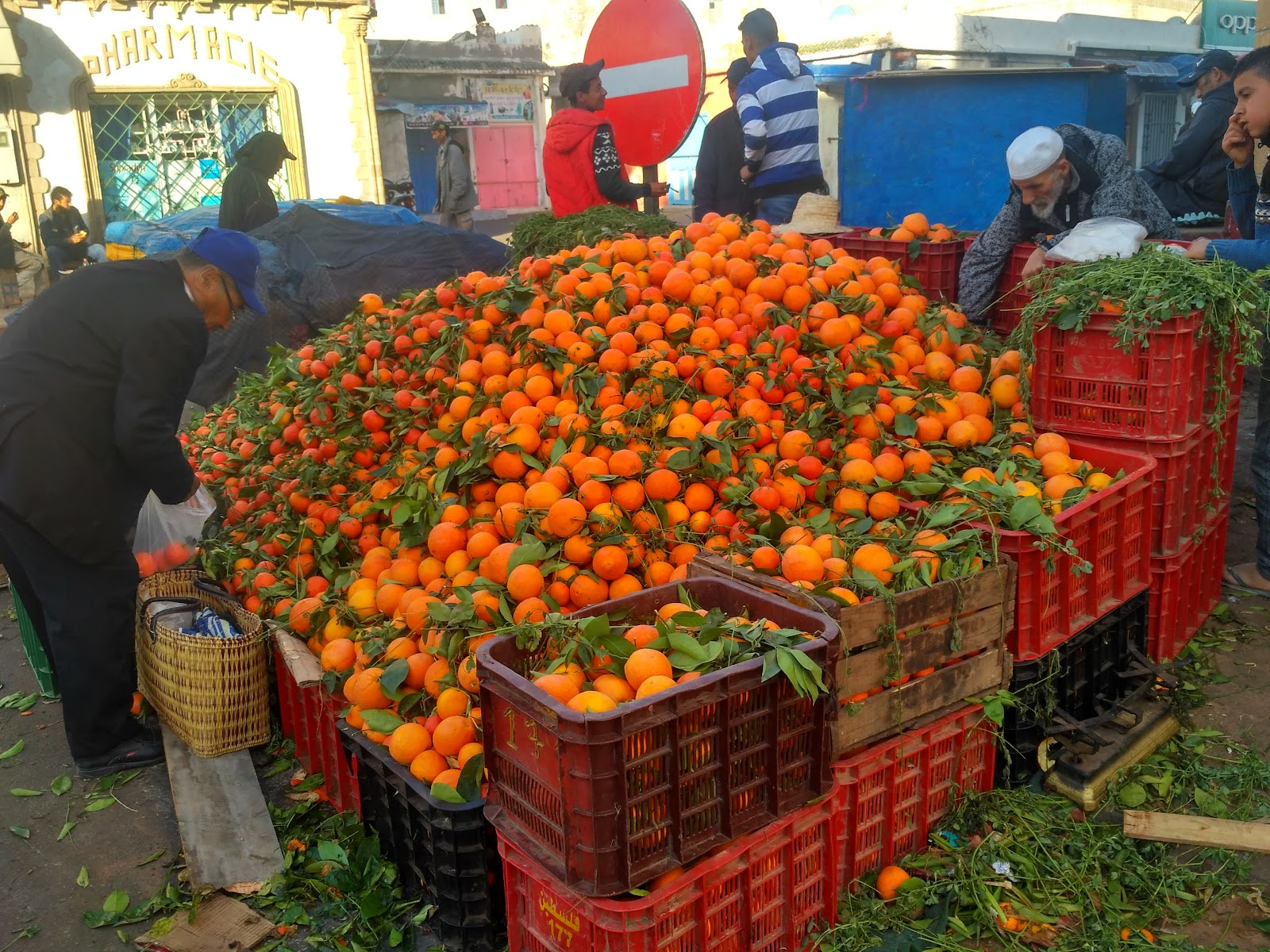

Moving on from Taroudannt took us back to Inzegane and then up the coast again to the small city of Essaouira.  It's got a history as a tourist hotspot stretching well back into the twentieth century, with such luminaries as Orson Welles, Ernest Hemingway and Jimi Hendrix having visited.  But the main attraction for us was that we'd be meeting my sister Melanie, bro-in-law Ka-Hung and Nephew Dante there.

It was a short walk from the bus station to the square in the Medina where they were staying.  As we turned the corner into the little plaza we were greeted by a couple of souvenir shops, six cute little restaurants and two big hugs from Mel and Dante.


They showed us into their home a lovely four and a half story Riad that had been arranged by their (now also clearly our) friends West and Julia, who had already been there with their son Levi for almost two weeks.

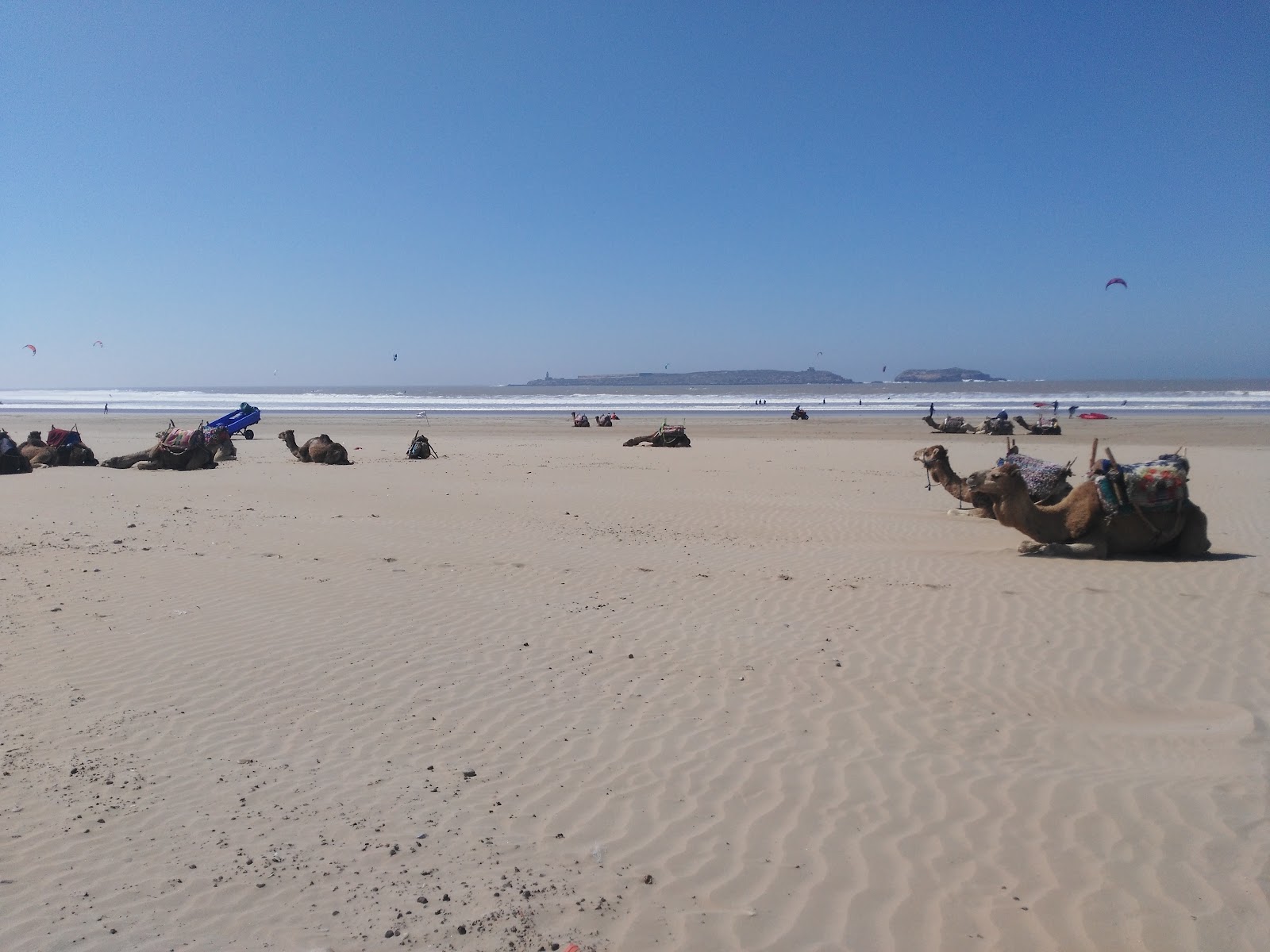
Essaouira does have a lot of charms.  A broad, beautiful beach. Good wind and waves for surfing (or boogie boarding, which Dante and Levi did, or kitesurfing, which West and KH were going to have a go at after we left), a pretty, fun, bustling souq.  And a high density of tourist-focussed but chilled-out, low pressure shops and restaurants.


We spent time at all of these, but my favourite parts of Essaouira were at home.  The Riad had a lovely rooftop terrace where we spent many an afternoon sipping coffee or OJ, or trying out more varieties of Moroccan wine and beer (for which one had to go into a nondescript little shop outside the old town and order from behind the counter, receiving the illicit goods individually wrapped in newspaper).

I played several games of trivial pursuit with Dante and Levi, who made very creditable efforts to unseat the self-declared master.

We watched the boys play football with EVERYONE, from neighbourhood kids nearish to their ages of 12-13, to impressively skilled teenagers and young men on the beach, to the guys selling trays of “space cakes,” and hash cookies on the beach, who didn't even put down their trays to join the games.

We made several yummy dinners, including a memorable one of grilled fish and charred, smooshed eggplant ooked on the charcoal burning base of a tagine in the alley outside our riad.


Our final night in Essaouira was a Friday, the day that Moroccans usually gather with family for an evening meal of couscous.  As we were a big family ourselves it seemed entirely appropriate to go to a nearby restaurant (located simply by asking one of our Moroccan neighbours where to go for couscous) and join in on the tradition.  I was amazed that we managed to finish the massive pile of couscous, lamb chops and veggies, even though there were eight of us working at it!

From Essaouira it was almost time for us to depart from Morocco.  We'd planned to leave ourselves a day or two in Marrakech before our flight, but we'd had such a lovely time with Mel, Dante, KH, Julia, Levi and West that we'd stayed with them right up to the last possible moment.

We took a bus to the big city and on the way spotted dozens of goats up three large argan trees.  It was super fun to see them, but as there were almost the only arboreal goats we saw during our week or so in Argan country, and as they were on a major tourist route neat Argan oil shops I can't help but wonder if they were somehow induced up the trees…


In Marrakech we had just enough time for a quick walk through the Medina and a coffee in the famous Djemma al Fna square.  As in Fes, the much talked about pushy or irritating salespeople, fake guides and scam artists didn't really seem to appear (not even the high-pressure henna artists in the square!)

Indeed, if anything our experience in Marrakech went the other way.  Having run the tourist gauntlet we were walking up the street, trying to confirm that we were on the bus route to the airport and to find out where we could get aboard.  A tuktuk driver stopped and, when told that we only had ten dirhams left (enough for the bus but not much else) spent a good ten minutes flagging down share taxis and trying to confirm them to take us to the airport roundabout for that.  This would have been a fair fare, but when the drivers saw we were foreigners they wouldn't have a bar of it. So it took a fair bit of convincing on OUR part that we were really okay with taking the bus before he was willing to drive us a few hundred metres down the street and leave us at a stop.

At the very pretty and modern airport we sneakily drank our traditional airport beer outside (Stork: Best Quality!) Before heading through security.


Our time in Morocco had been great, most especially the time with friends and family in Essaouira.  And we'd left huge swathes of the country untouched, including the snowy High Atlas mountains and the sandy dunes of the Sahara.  But we made plans for a return to Spain, timed just right to catch the fabulous fiery Fallas festival in Valencia, which is where we'll pick up our narrative next time.

Thanks are due once again to the fabulous hosts who gave us such a warm welcome to Morocco: Anouar and his family in Fes, Gareth in El Jadida and, once (and deservedly) again, Julia, West, Levi, Dante, Mel and Kahung for sharing their holiday with us.


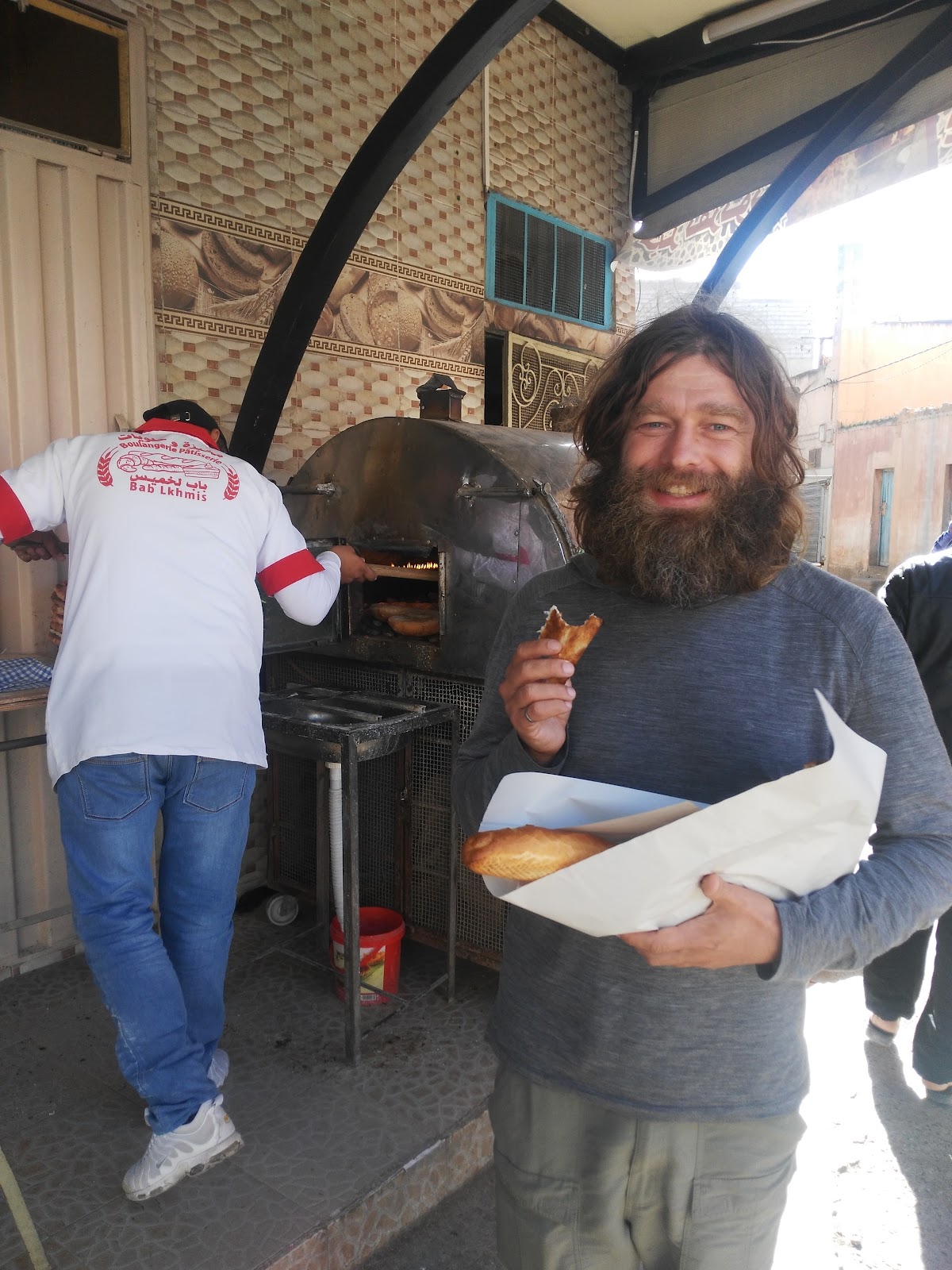
P.S. One really fun bit of Morocoana that I forgot to mention is how everywhere I went Moroccans, mostly young men but everyone at various times, would smile and say/yell “Ali Baba!” as I passed by.  Apparently “Ali Baba” is what Moroccans call anyone (other Moroccans included) with a big beard. So Ali Baba can join Karl Marx and Francisco Pizarro as a nickname my beard has garnered me.

Monday, 1 April 2019

A Stroll Through the Anti Atlas

From El Jadida we had a full day's travel ahead, and then some, before we reached our next destination, the town of Tafroute in the Anti Atlas mountains.

We'd hadn't even been entirely sure of our destination and so had ended up taking the next bus to a transport hub in the right direction and seeing how far we got.  On the way down to Agadir (or more precisely, Inzegane, said transport hub on the outskirts of Agadir), we saw some nice coastal scenery and an even nicer goat. The area around Agadir is the centre of the Argan oil industry.  The Argan tree is endemic to Morocco and, in a process similar to that of southeast Asian civit coffee, produces a highly sought after oil. Goats love eating the trees’ fruit and after they've digested its outer layers they excrete the central nut which is cracked and pressed to produce an oil used in both cuisine and in cosmetics and hair care products. So fond of these fruits are the goats that they've taken to climbing argan trees to get at them.  We saw lots on their hind feet reaching up into the trees to get the low hanging ones, and one adventurous goat standing amongst the branches right on top of a large argan tree, queen of all she surveyed.

On arriving in Inzegane it was getting late and we couldn't quite decide what to do.  We could spend the night there, but it didn't look like the most salubrious location. Or we could take a bus to the town of Tiznit, our final stop south before heading inland.  The fact that we almost stumbled into a share taxi headed there made our decision for us, and had the added benefit of getting us there right around sunset, with a bit of light left in the sky.


A word about taxis in Morocco: there are two types: petits taxis and grands taxis.  Petit taxis are used for short trips around town only and are usually small modern cars which, despite having four free seats are only allowed to take three passengers.  Grands taxis are typically ancient Mercedes-Benzes, ply intercity routes, often on a price-per-seat basis and, despite having four free seats, take six passengers, two in the front with the driver and four in the back.  I still liked them fine for trips of up to 90 minutes or so though, as they're faster than the buses and the pricing is rigidly standardized by conductors at each town's grand taxi stations.

Anyhow, on arriving in Tiznit we walked to the main square and found a delightfully clean, colourful and cheap hotel and went out for a walk around the square and the adjacent Medina.

The main Medina streets were entertainingly busy and our search for a dinner restaurant led us to a little sandwich shop with a queue out the front (always a good sign).  The place sold only two items, deep fried sardine sandwiches with a chopped tomato and onion salsa, olives and hot peppers; and plates containing pretty much the same ingredients in larger quantities.  The sandwiches were delicious and set us back a mere NZD 0.90. While we were queuing a (trying to be) friendly guy smelling strongly of solvents came and tried to shoo people out of the limited seating while we waited, but was eventually convinced that we didn't mind standing in the queue like everyone else.

On our way back home we grabbed some tooth-achingly sweet (but very tasty in small quantity) Moroccan pastries for dessert.


The next morning we had a further stroll round the Medina during which Sarah picked up a pair of riotously loud yellow embroidered Moroccan slippers to replace her Brazilian parrot-patterned shoes that were rapidly reaching the end of their lives.  In another queue-induced food purchase we also picked up some Berber bread. Baked on a bed of hot stones like Iranian sangyk, it was almost as good, with a crispy, lightly charred outside and a delicious soft interior. We got one hot from the oven and finished it before it was even close to cold.


Heading inland from Tiznit wasn't quite as straightforward as it might have been, with travel guides and locals alike giving different ideas about where to find the bus up to Tafroute.  We followed a combination of these and ended up spending over two hours waiting on a dusty streetcorner on the outskirts of town. City buses did pass by, but none bearing the correct number or destination on the front.  We eventually gave up and walked back into town intent on finding a Grand Taxi when, before we even had a chance to discover where THEY departed from, the number 20 bus to Tafroute appeared in the distance.

It took us on a winding journey through tiny villages and up into the parched landscape of the Anti-Atlas foothills.


Three hours later (longest city bus journey ever?) we'd arrived in Tafroute.  It wasn't a big town, but had waaaay more tourism industry than we'd thought. There were literally hundreds of European plated campervan parked outside (Morocco off the beaten track my foot, Lonely Planet!)

We found a hotel and, by virtue of having been treated very nicely by the cafe staff at another hotel that was full when we asked, a lovely place for dinner.

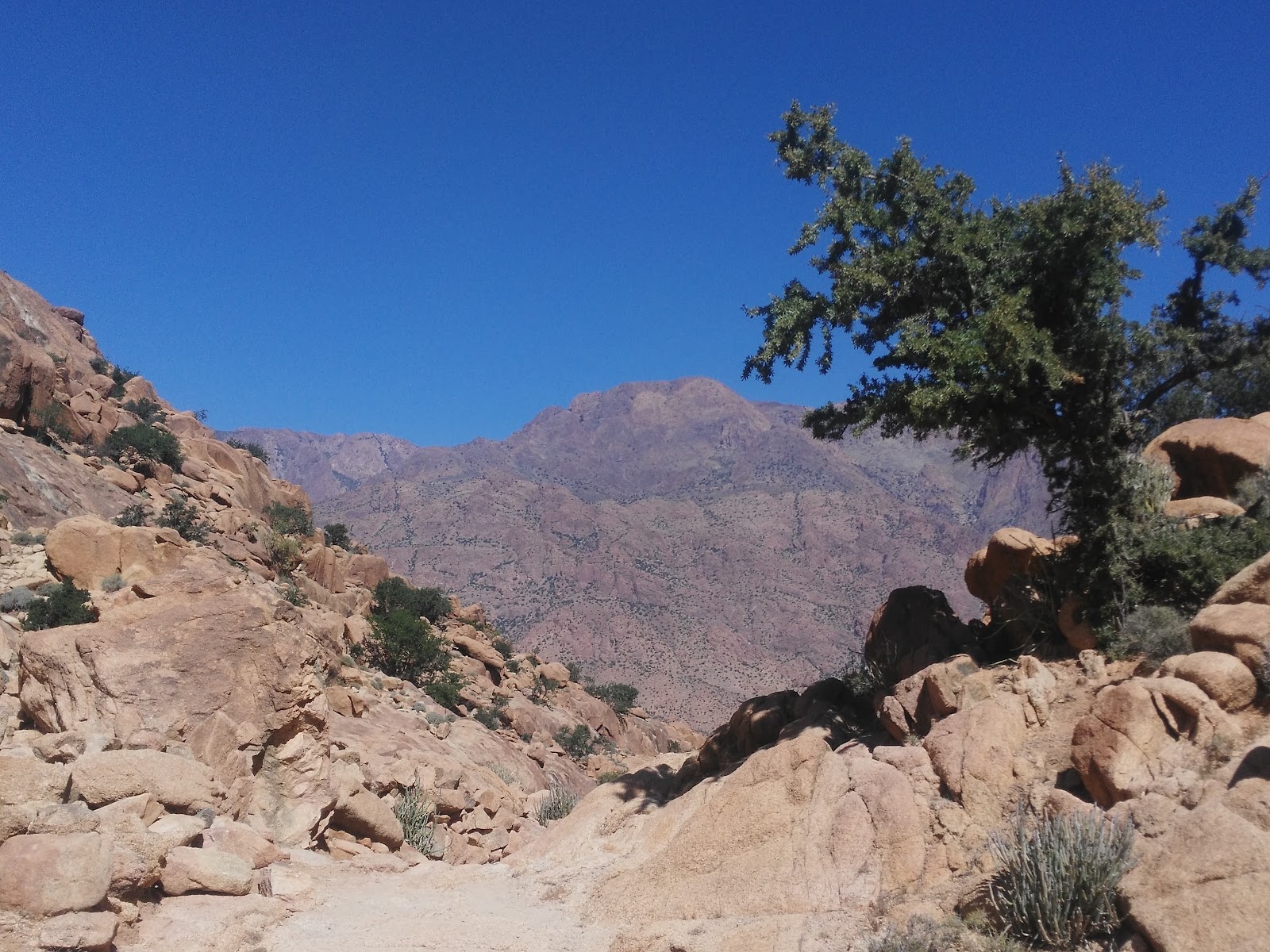
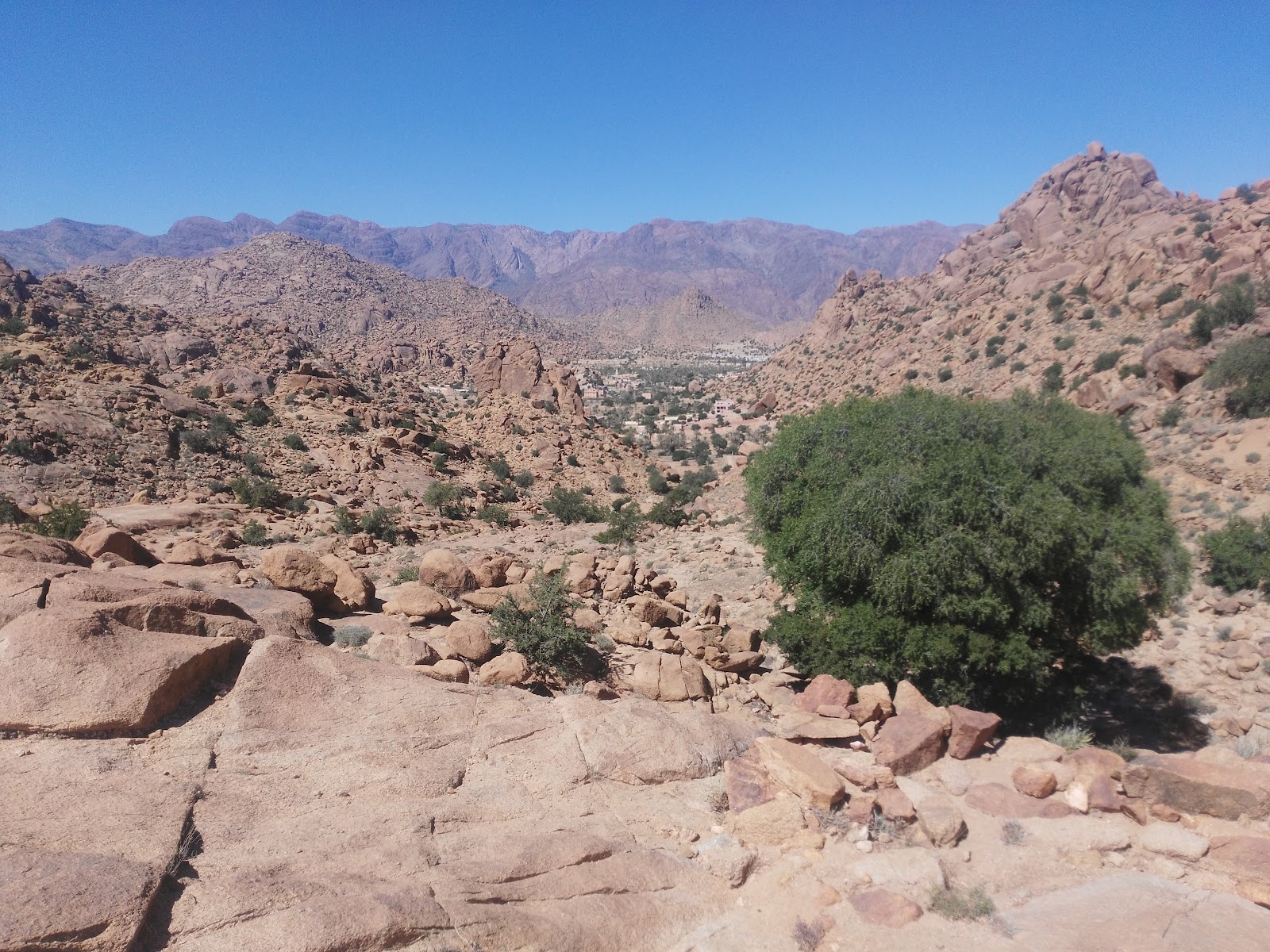
Complaints about Tafroute's business vanished the next day when we went for a walk out around the town.  As in Azrou, we followed a mix of downloaded GPS tracks and trails marked on OpenStreetMaps. And were led on a beautiful but not difficult walk over a low pass in the rubble-strewn ochre landscape and into the next valley.  From there we did a bit of road walking and then veered off again. We found a picnic spot under an Argan tree with not even the faintest sign of humanity in any direction. Signs of humanity were soon regained as we followed an OSM path through the ugly looking and uglier smelling town garbage dump.  But this wasn't near enough to dampen our enthusiasm for the beauty of the landscapes around Tafroute.


Our second day took us on another day walk out into the massive rubble-strewn desert around town, this time taking a loop that led to the Piedres-Peintures, a spot where some of the huge rust-coloured boulders had been painted blue and pink. The first of these had been done by a Belgian artist ten years previously, but copycats had soon taken on even larger sections of the surrounding mountains.  It wasn't entirely unappealing, but did leave you questioning the line between art and vandalism.

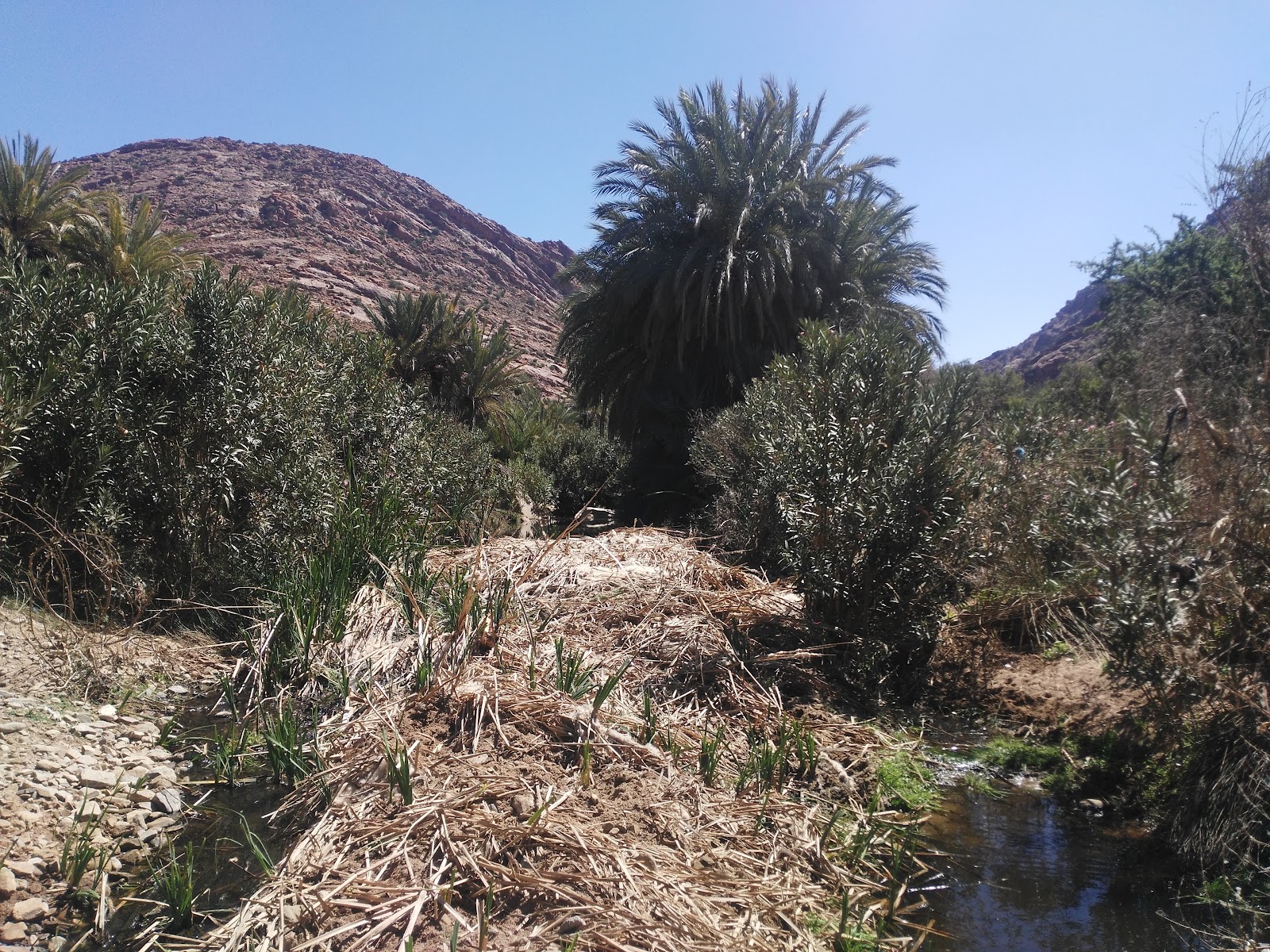
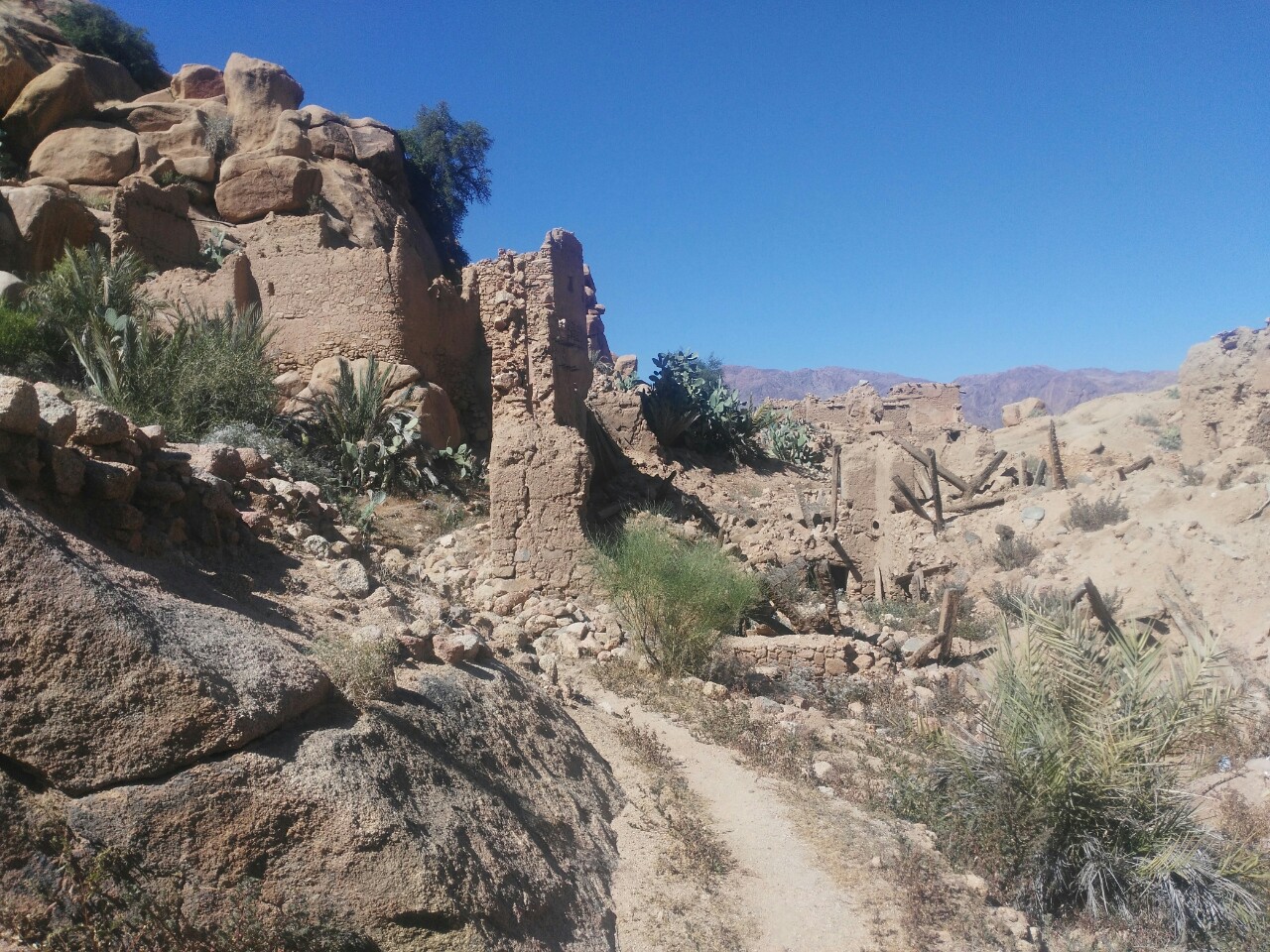
The walk back into town down a steep, broken valley bottom probably produced the prettiest vistas of all, unless they were eclipsed by the crumbling mud-walled buildings in a mostly abandoned village of a couple of kilometres down the palm-lined riverbed from Tafroute proper.


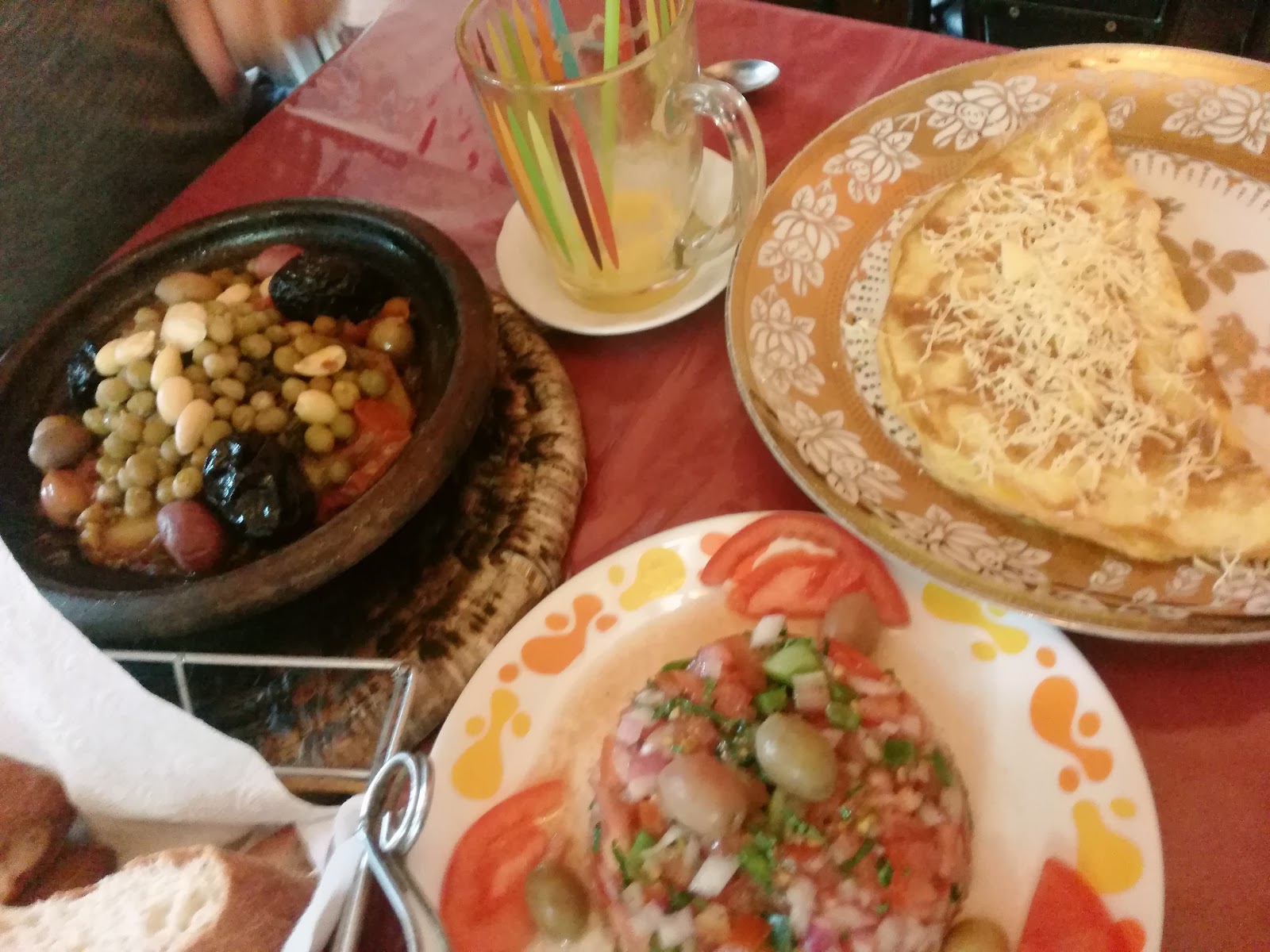
That night we rewarded ourselves for the modestly difficult and long (maybe 12km on the first day and 17km on the second) hikes with a big dinner, featuring Moroccan salad (tomato, onion, green pepper, parsley, vinaigrette), omelette, beef shank Tagine with prunes and almonds, coffee, some of the best freshly squeezed orange juice I've ever had and a dessert salad of sliced oranges, mint, cinnamon and honey.


We could probably have comfortably stayed longer in Tafroute, following a similar itinerary for several more days, but the road (and our schedule) called.  We were headed to the small city of Taroudannt. Less than 100km as the crow flies north of Tafroute, the direct route was through rough Anti-Atlas roads and there was no public transportation of any sort available.  So back we went on a bus to Inzegane via Tiznit (at least it was quicker and via a different, equally scenic route than the one we'd taken on our outward journey). At Inzegane it was into another Grand Taxi for the journey back inland again. But I think I'll save that journey for the next entry...

Sunday, 31 March 2019

The Atlas to the Atlantic Via Rome

We'd taken a very roundabout route to get to Meknes, which is really only about a 45 minute trip from Fes.

At first, and over much of our stay there it seemed a world away.  Things were busy when we arrived, but as soon as Friday Prayers began everything quietened down to almost nothing.  The streets mostly emptied. The hotel we'd checked out earlier and decided to stay at was unattended for a couple of hours.  Even the Medina was almost deserted, with almost no one walking its alleys and virtually every shop shuttered.


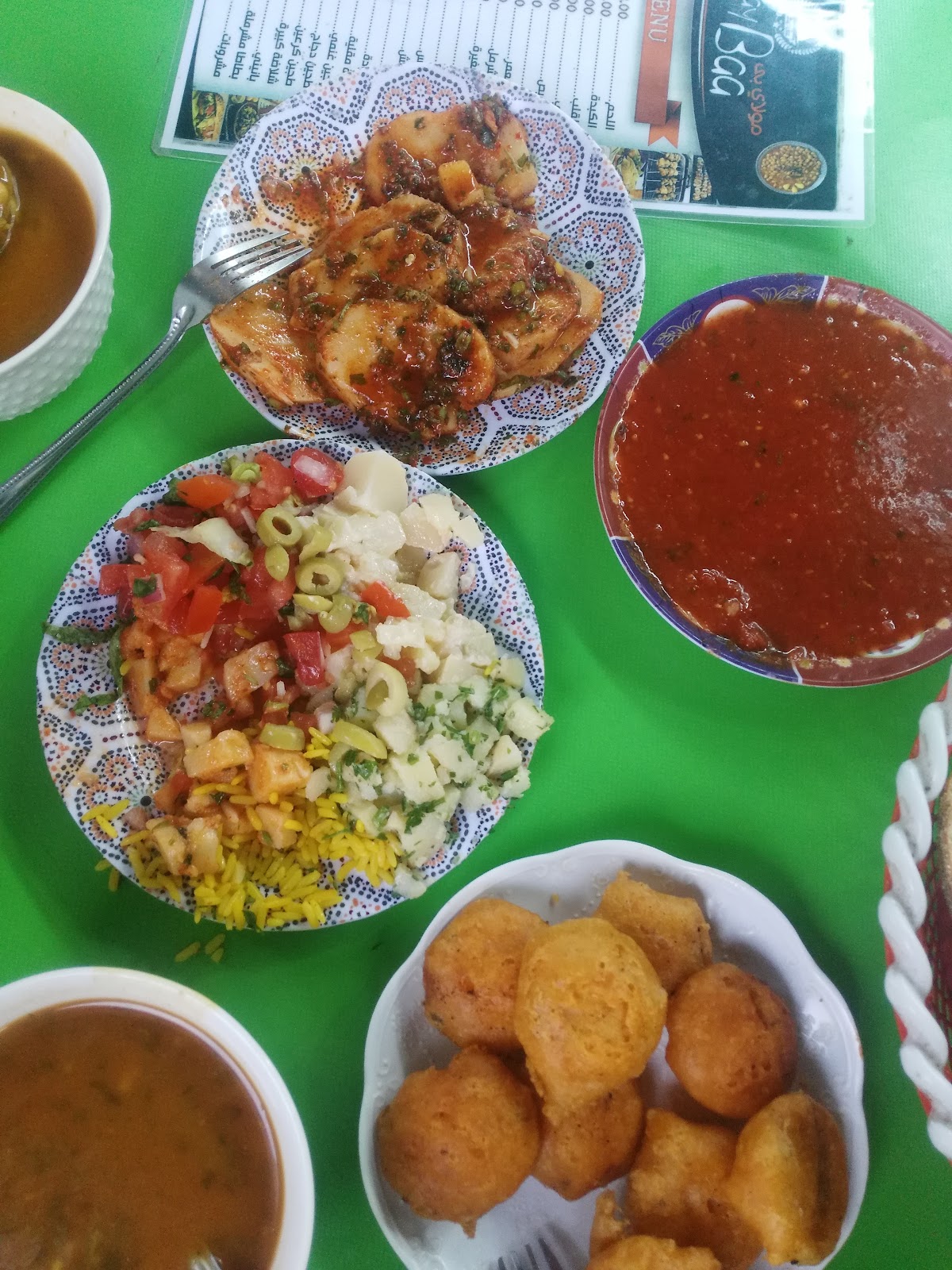
Our street, just outside the Medina and forming its southern boundary was one of the livelier ones, so after eventually managing to check in to our hotel and taking an extended walk through the Medina-cum-ghosttown, we did find several open restaurants.  The place we ate in Meknes became, if not our favourite in Morocco then at least the standard against which we judged all others. We had two bowls of Harira (delicious thick lentil, chick pea and noodle soup), a vegetable Tagine (a Tagine is pretty much anything cooked in a wide, shallow clay dish with a conical lid of the same name and is ubiquitous in Morocco) and a plate of deep fried potato patties, all of which came out to about NZD9.


We went to bed early in our basic, but clean and prettily tiled hotel, as we had a big day planned for Saturday.

We were up and out of our hotel before sunrise (at this time of year, a few weeks before the vernal equinox, this was surprisingly late, around 07:45).  The city was slowly getting going for the morning, and we were some of the first few people on the city bus headed out to the town of Moulay Idriss. As in Fes, we were surprised by how suddenly the city ended, and most of our journey was spent speeding along country roads, somewhat incongruously in a jam-packed city bus filled  with passengers and (further incongruously) goods for sale in Moulay Idriss including big piles of clothing and mannequins.

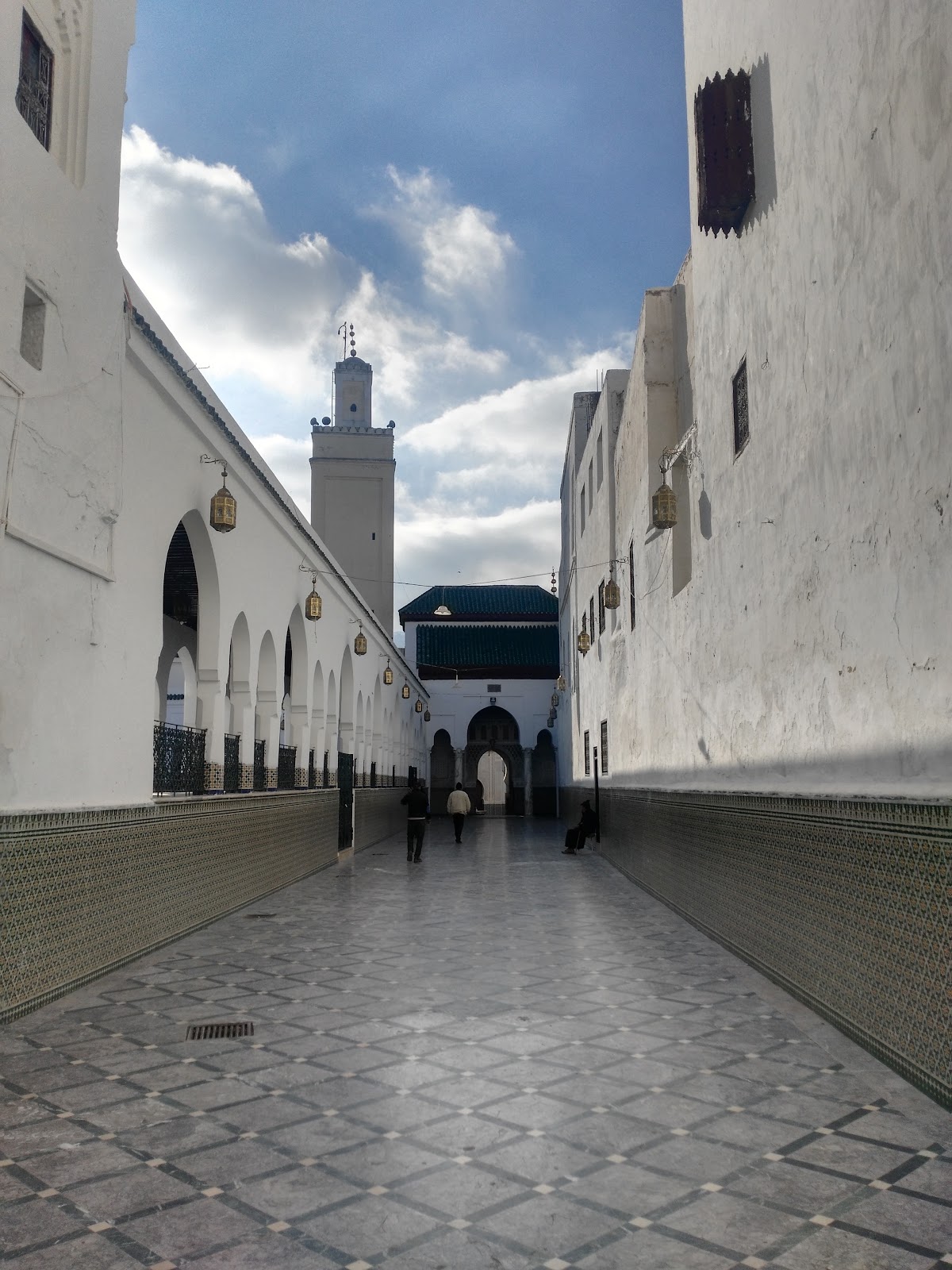
While our primary destination was the ruined Roman city of Volubilis, Moulay Idriss was a worthy destination in itself.  The first capital of Moulay (Mullah) Idriss, founder of the Idrissid Dynasty who introduced Islam to Morocco in 789, scarcely 150 years after the religion was founded a continent away.  Not much remains of its former glories, but the tomb of Moulay Idriss is an important shrine and pilgrimage site. And the town itself is postcard pretty, spilling down the slopes of two adjacent hills with the tomb and main square sitting in the saddle between them. We had a coffee on said square, and then paid a young man near the entrance of the tomb (non Muslims can't go inside) a few dirhams to lead us up the beautiful winding streets and alleys to a view out over the town.


Normally we'd have been happy to wander til we found it ourselves, but it was now almost ten o'clock and we still had the 5km walk out to the Volubilis site in front of us.  I can hardly imagine a more pleasant way to spend a sunny spring morning than strolling along the wide shoulder of the road through rolling fields and olive groves, the pillars and arches of an ancient city growing closer over the hour-long walk.

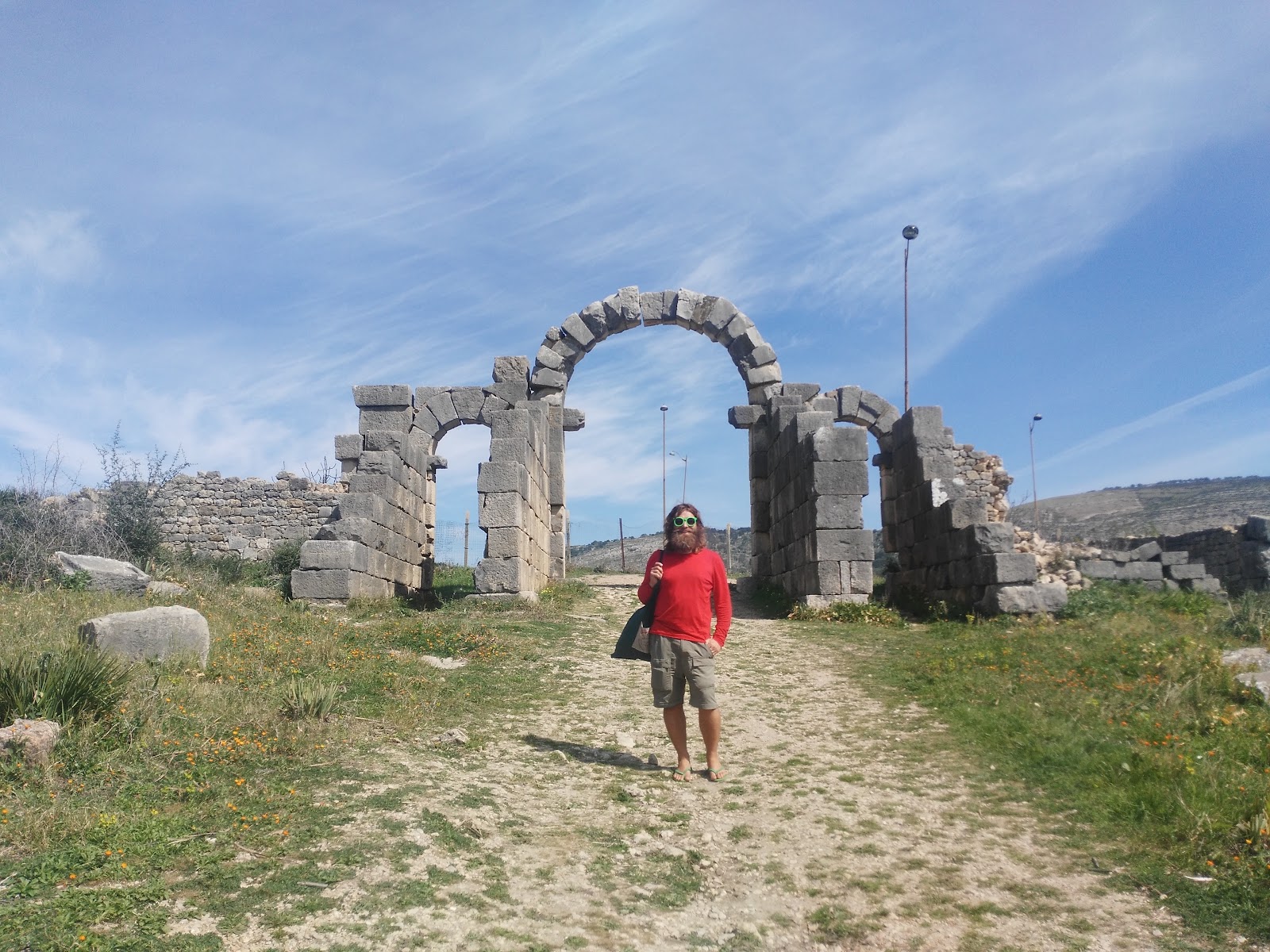
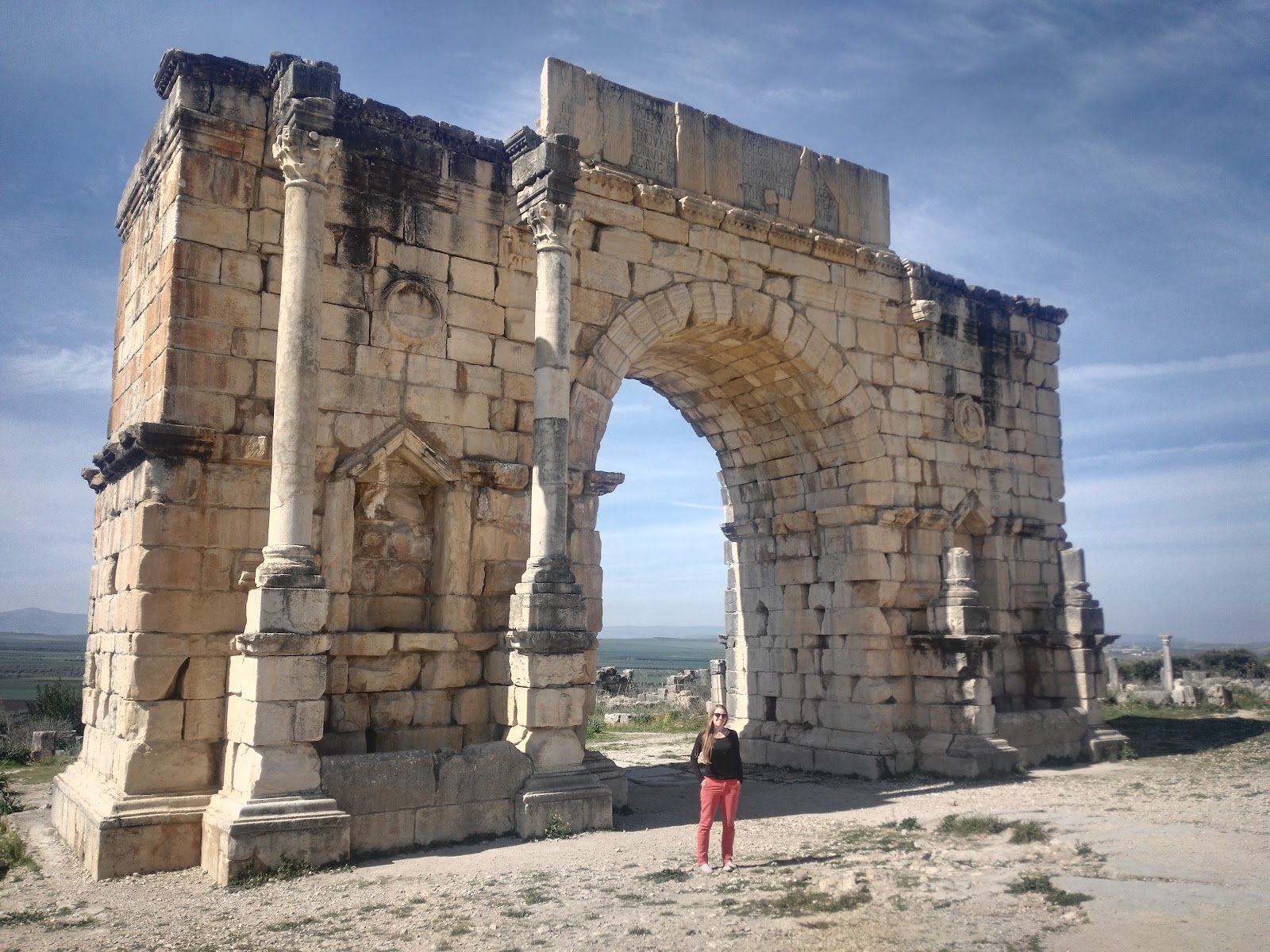
The Volubilis site began in pre-Roman times as a Phonecian city, and carried on well after as an Arab one.  But most of its legacy is Roman. It was a prosperous agricultural centre, manufacturing olive oil and flour for export.  The ruins of the common houses, gateway arches, public baths, mills and temples were impressive in size and fun to explore, but the real highlight were the mansions of the city's wealthy merchants, which contained an impressive collection of mosaics.  They were in great condition, some of them showing colours that looked so bright and fresh that they might have been laid a few weeks before.


There were lots of tour buses there, and plenty of Moroccan visitors who'd arrived in private vehicles or taxi.  But they tended to clump together in large groups so you really just needed to stop for a while or walk extra quickly whenever you encountered one and soon enough you'd have it to yourself again.


On our way home the walk was a bit hotter and sunnier, but still pleasant enough.  And as we boarded the bus down below Moulay Idriss on the main road, it was much busier when we got aboard.  Buy hospitable Moroccans fairly quickly insisted that the visitors ought to have seats, with no hope of refusal, so we made the 50km journey back to Meknes in relative comfort anyway.

Back in town, the day of rest behind them, merchants, snake charmers and storytellers  in the square were doing a bustling business with large crowds of locals and visitors alike.  The Medina was once more a hive of activity. And our previous day's afternoon coffee spot on a sunny terrace looking over the new town, had plenty of custom as well.


We visited all of these, as well as the (remains of the) palace complex and tomb of Moulay Ismail, the 17th century king who had made Meknes his capital.  The whole experience was like a toned down version of Fes. Smaller and less energetic, but almost entirely without the (limited) hassles of its more famous cousin down the road.

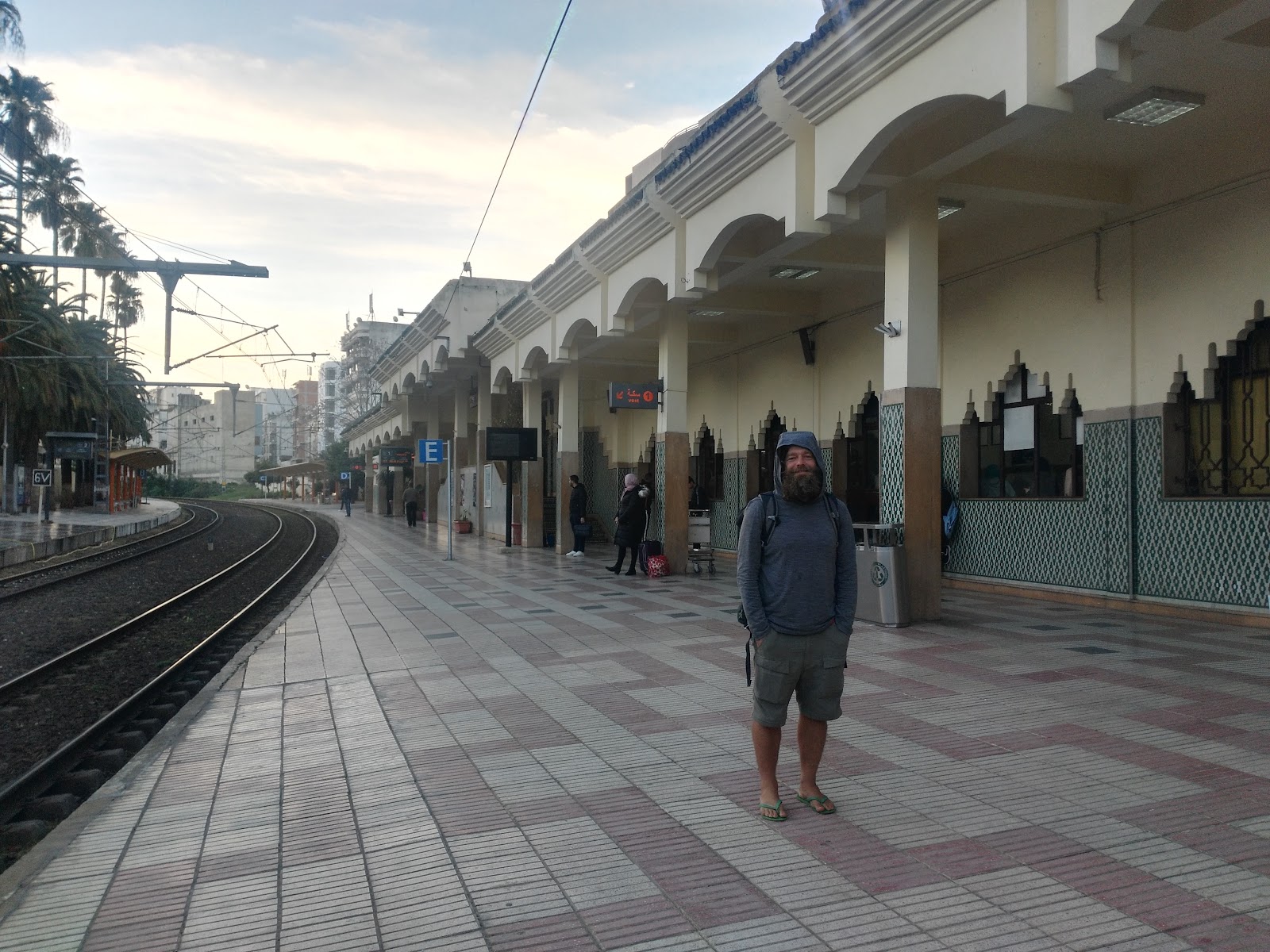
The next morning we woke up even earlier, once again well before sunrise and walked to the nearest train station in the new town to catch a 07:53 service to Morocco's modern capital, Rabat.

The train ride was great.  Smooth, quick and quite comfortable in a nice modern carriage (even in second class).  


Rabat is often written off as a bit boring and lacking in the grandeur of Morocco's other imperial cities.  But it was on our way, so we decided to stop for an afternoon and evening and have a look around. It was definitely worthwhile.

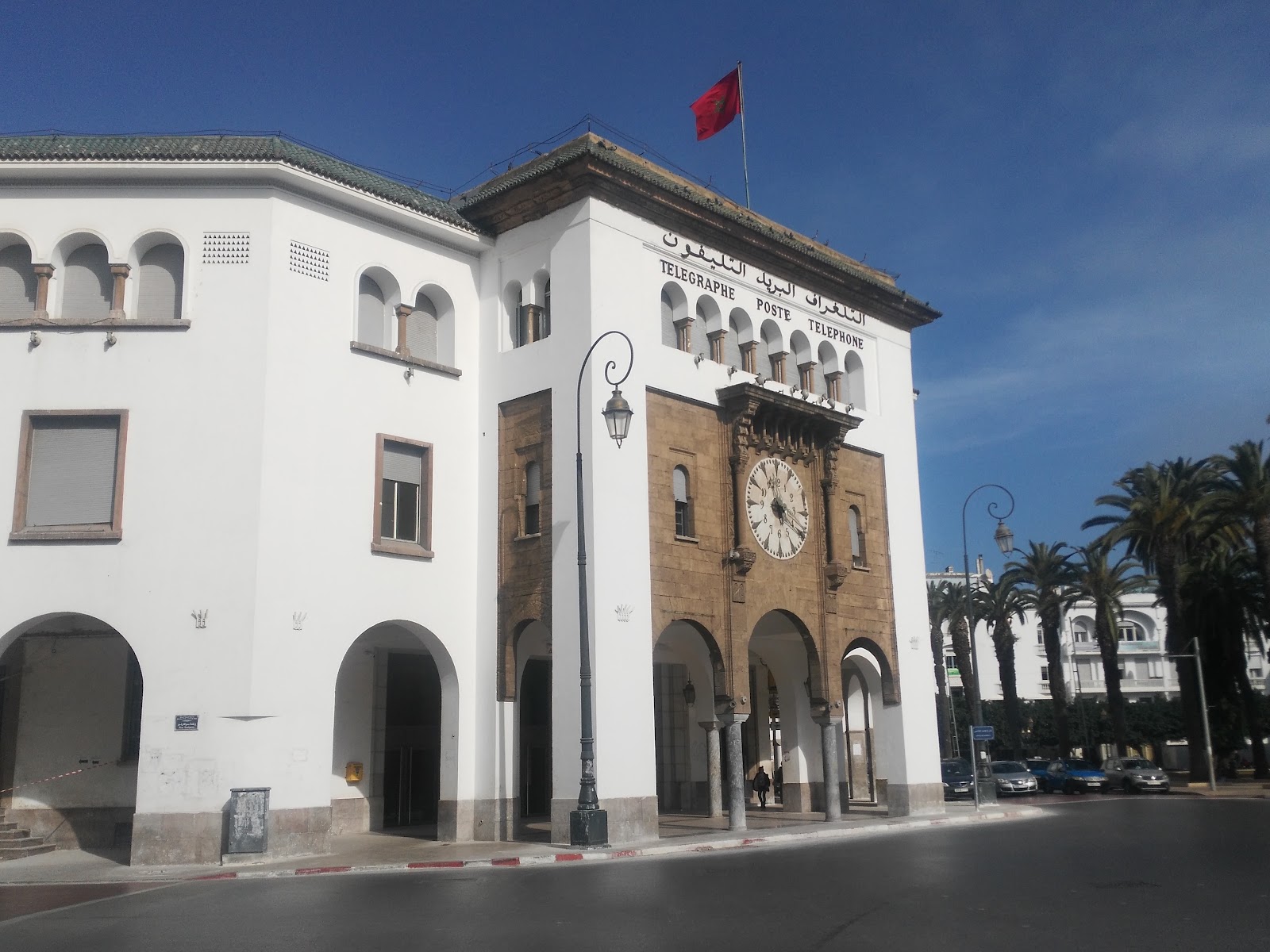
Our walk to our Airbnb took us along the main drag of colonial and modern government buildings, monumental, white and palm fronted.  


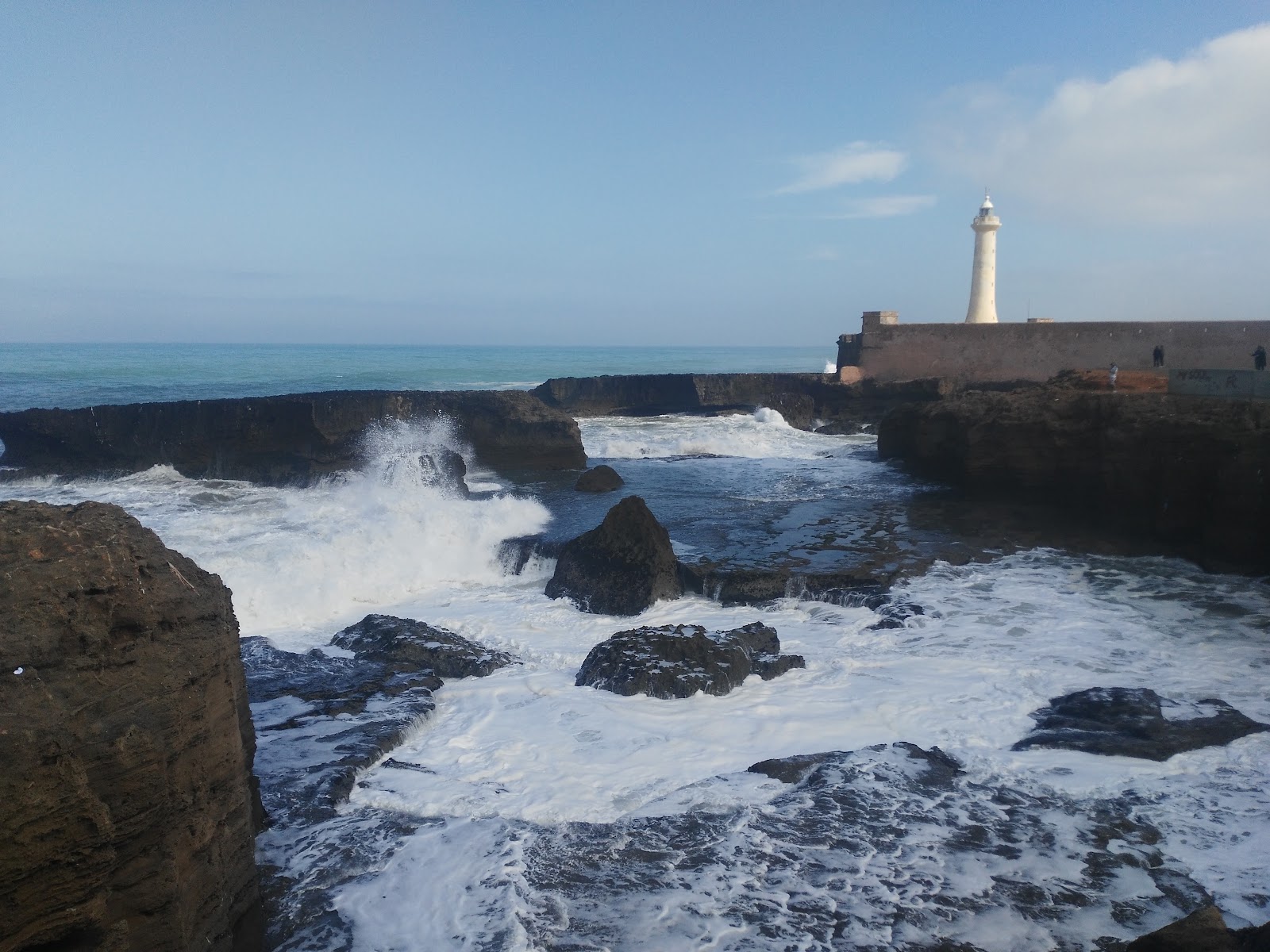
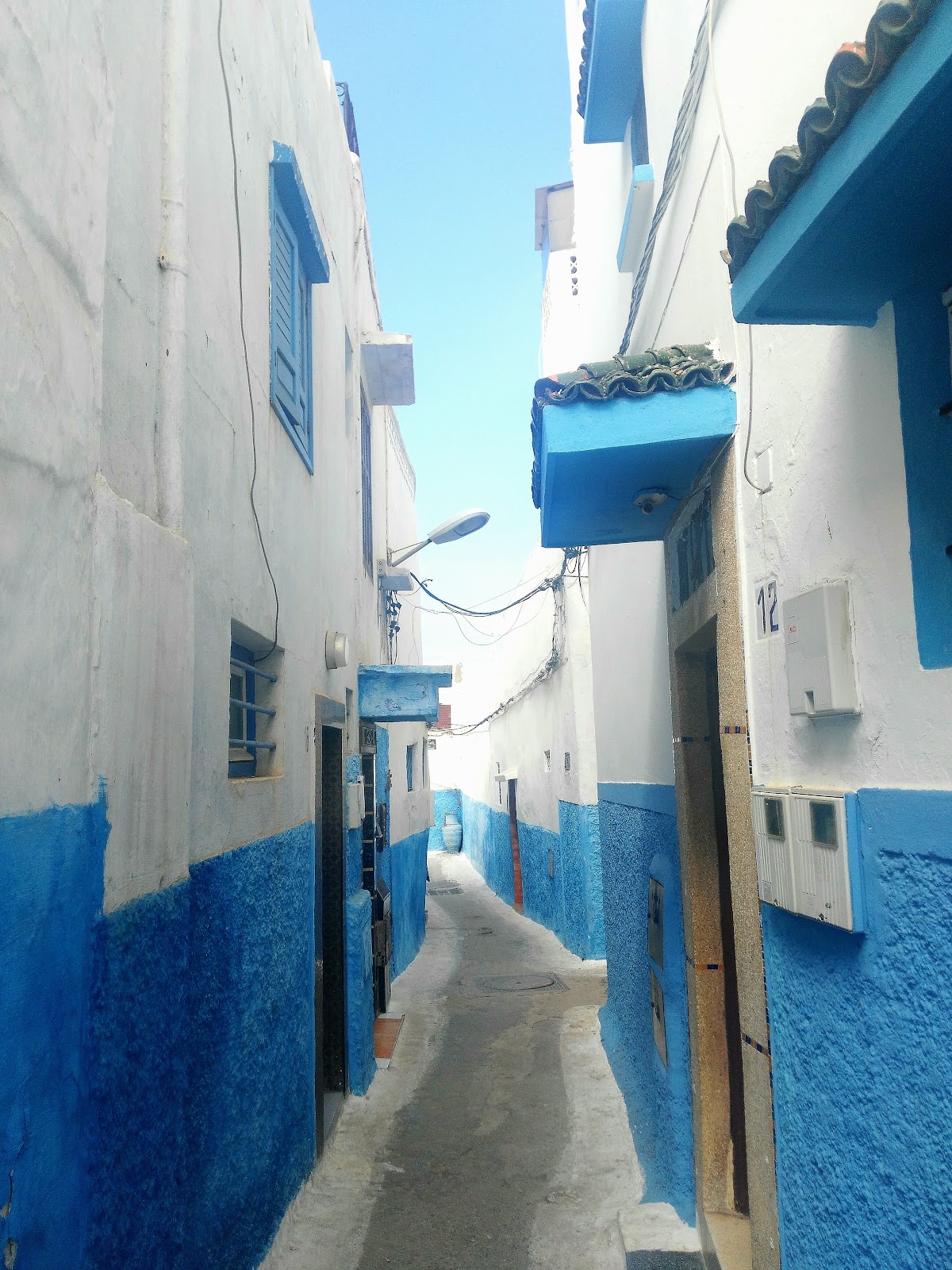
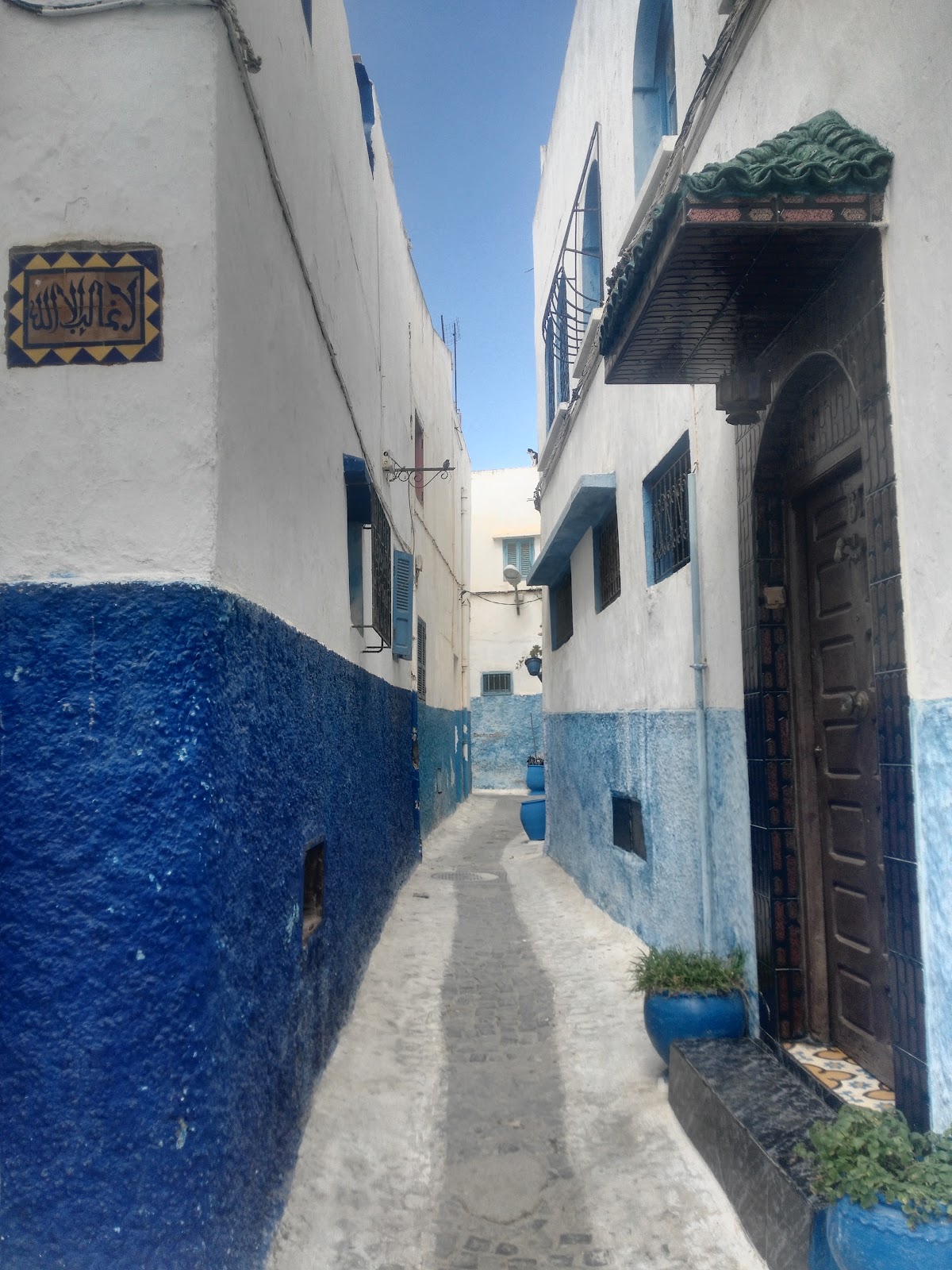
The Atlantic was sending big swell onto the shore and the waterfront was coated in salty mist by the huge waves smashing into the rocks.  Further north past a breakwater, the bay was filled with surfers who simply walked to the end and hopped into the water, saving themselves the trouble of paddling out. Then in the blue-painted Casbah (fortress) looking over the oceanic turmoil we had a pleasant wander through a residential area and French designed colonial era gardens.


Across the street in the Medina, Sarah got her hair cut.  The salon was a tiny space inside a Medina doorway with a curtain covering the front (no men allowed inside, or even looking that way).  The lady got the length about how Sarah wanted it, but had very much her own ideas about what sort of style suited her, so Sarah ended up with a fringe that wasn't entirely in her haircut plans.


Our final stop for the day was a former imperial mosque. Former because it was destroyed by an earthquake and only (very) partially restored.  All that really remains today are the somewhat abbreviated minaret and the floor plan laid out as a series of partial height columns. But it still looks pretty cool and judging by the number of people picnincking, posing for photos and playing amongst the forest of columns, its still a popular spot for Morrocan and foreign tourists and Rabat residents alike.


For dinner we contented ourselves (as we did for maybe half of our meals in Morocco!) with bread, olives and tomatoes.  The bread was usually either round, soft Moroccan loaves, or crusty French baguettes (another legacy of the colonial era).  The Moroccan bread was more reliable, but the baguettes were often good, sometimes very good, with a crispy, crusty outside and a dense chewy interior.  The olives meanwhile, were pretty much always great. Dedicated olive shops would be fronted with great piles of multiple varieties. Often they'd be flavoured with preserved lemon, or parsley or ground nuts or garlic or hot pepper or various combinations of these.  And at around NZD2.50 a kilo it's no surprise that we ate lots and lots of them.

It was yet another early morning for transportation as we returned to the station, this time heading southward along the coast via Casablanca (where we stopped for a coffee and to change trains) to the small city of El Jadida.

We arrived just after noon and were met at the station by my friend Gareth.  We know one another from my annual visits to the World Boardgaming Championships in the US, where I think he is probably the only regular attendee from Africa.  We headed back to his place and met his roommates Austin, She and (the one whose name I've forgotten) (cats) and Douschka (small dog, who was the newest addition to the family).  Douschka had just recently been spayed, and so was wearing a cone round her neck to keep her from biting at her stitches. The cone led to lots of intrigued questions from Moroccans as we took her for walks on the nearby beach.  And the operation itself led to Gareth's Moroccan co-workers going from regarding him as a kind gentleman for rescuing a street dog to seeing him as a big meanie for denying his pet the joys of sex and motherhood.

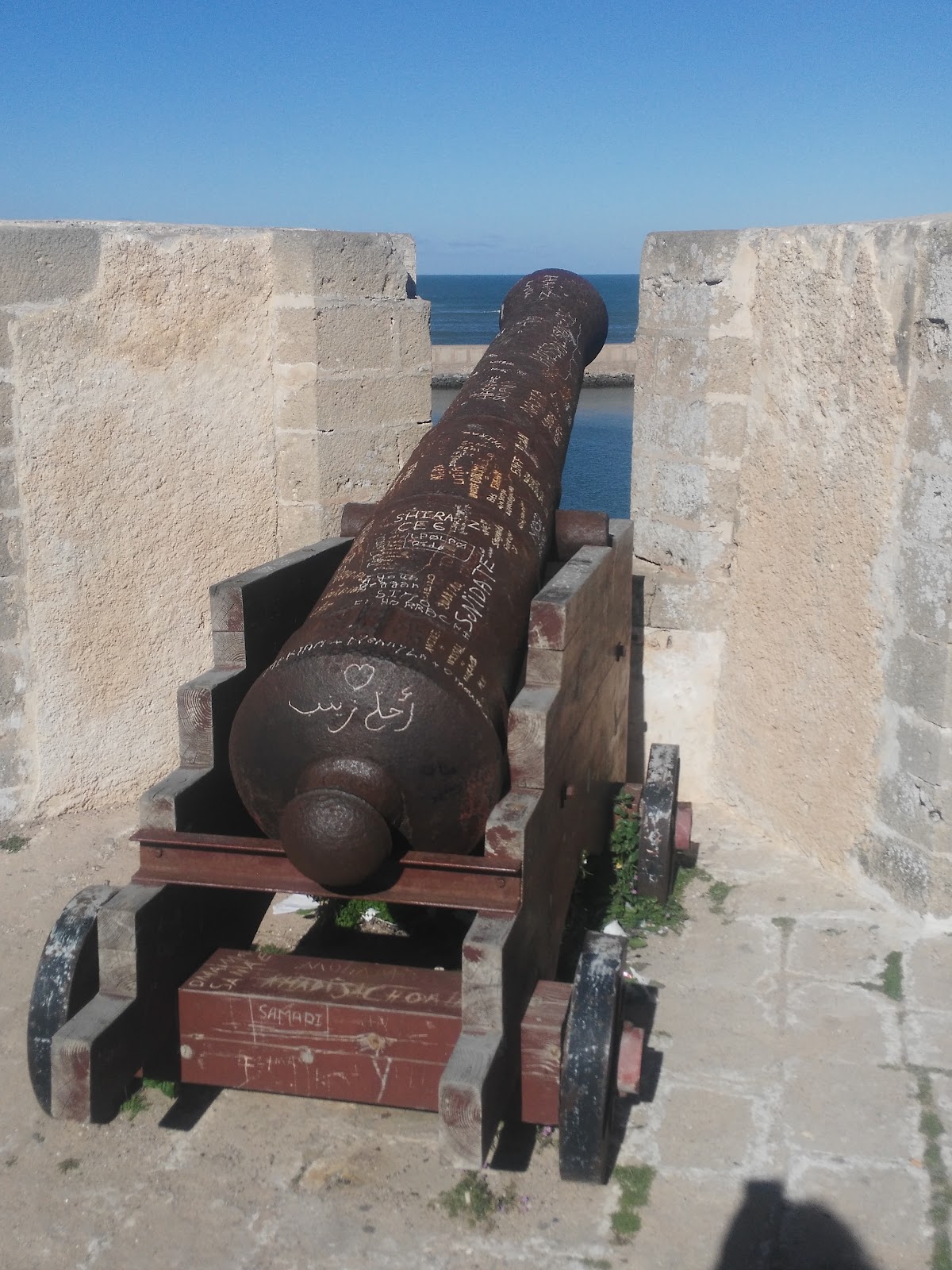
On our first afternoon with Gareth we had a look around the old Portuguese fortress at the centre of town.  We had a fabulous lunch at a fancy restaurant (roughly four times the price of our meals in Meknes, but that fish Tagine… perfectly cooked and packed full of delicious herbs and caramelized veggies…)
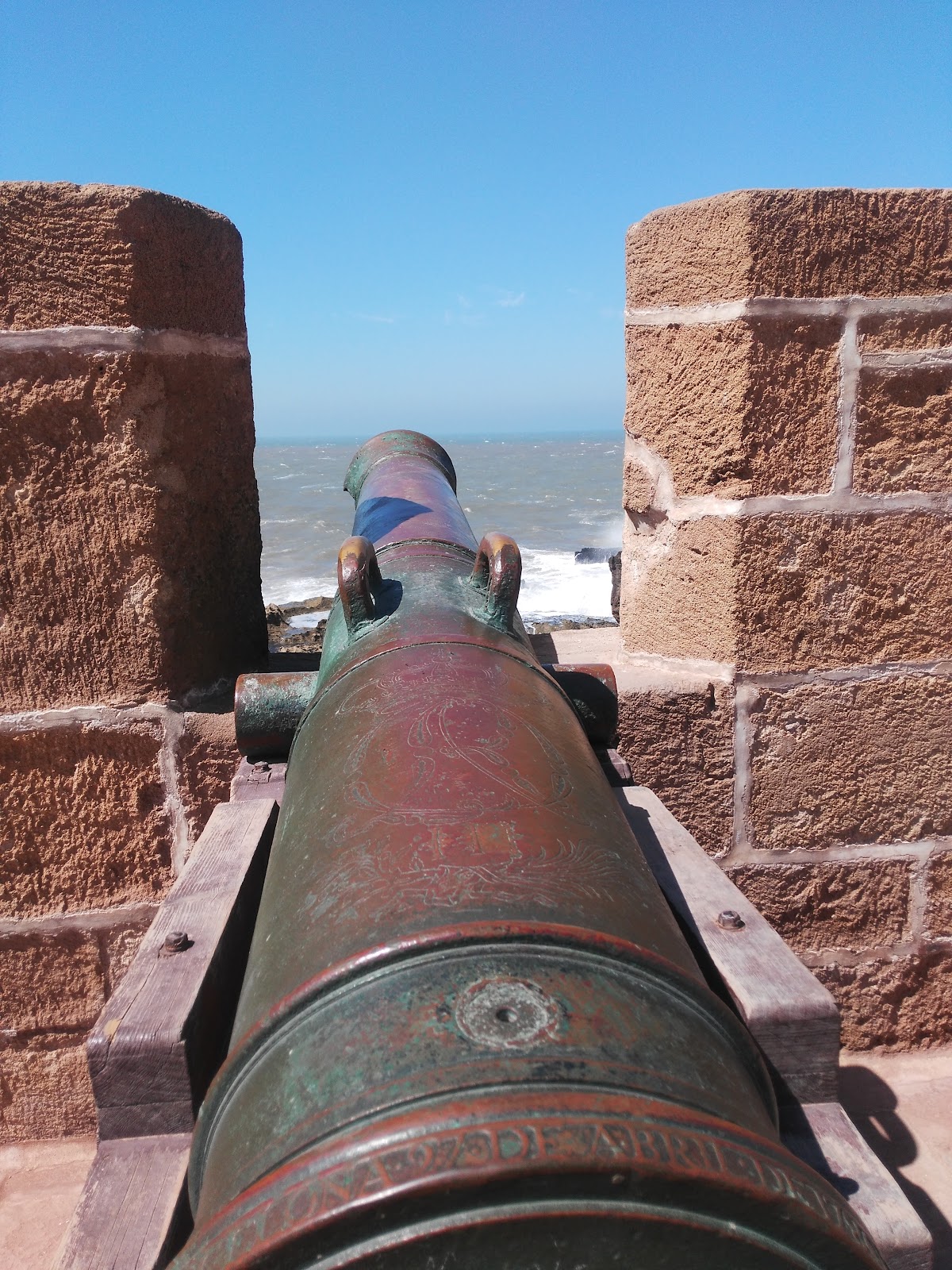
We went for a walk up on the ramparts and took a visit down to the cistern, whose magical atmosphere is perfected by the shallow pool of water they allow to remain on its bottom, forming a perfect mirror of the arched roof and well opening above.


We finished the day with a drive out to the even more lovely Sidi Bouzid beach South of town to take Douschka for another walk and then to enjoy dinner on a rooftop terrace overlooking the Atlantic.

Back home before bed I got to try my first two Moroccan beers: Flag (pretty average boring international lager) and Casablanca (surprisingly okay pilsner).

The next day we took a road trip down the coast road.  It was a weird mix of lovely (wild beaches and rocky points) and yucky (phosphate factories, petrochemical plants and a coal fired power station).  But Oualidia, where we stopped for (another delicious seafood based) lunch was magical. It had a huge lagoon, mostly blocked from the wild, ragged waves of the Atlantic by sand dunes, and probably the loveliest beach yet.  It's no wonder it's a major beach resort in the summer. In March, however it was pretty quiet, with only boatmen offering rides out on the lagoon and guys on mopeds selling oysters to distract from the tranquility.


Back home we prepared a dinner of curry and roti (a wee taste of home for Gareth who, though having lived in Morocco for nine years, is originally from the UK).  While cooking and eating we tried our first Moroccan wine. Alcohol is legal in Morocco, but licenses to sell it are few, and it's usually tucked away in dark dusty shops or segregated corners of a few select supermarkets.  The wine was surprisingly good. We had two (genuinely “gris”) pinot gris and enjoyed them both. Morocco's winemakers have obviously made the most of their hot, dry Mediterranean climate and the French legacy.


Later that evening Gareth and I talked games a bit (I was distressed to learn that I'm statistically the worst player in WBC history at Napoleonic Wars, though I blame this on the fact that I actively seek out opportunities to play long-suffering Austria).  And Gareth showed of the prototype of a his Wars of the French Revolution game that I'm honestly excited to try out.

And that was our busy visit to El Jadida.  The next morning Gareth drove us to the bus station in town, we (with the assistance of learning where and when buses were departing to) decided on a destination and we were once again off to explore more of Morocco.