Our second trip to Georgetown began with a walk through town in the pleasant cool of the morning. Central Georgetown, and indeed almost all of the city, is flat and fairly small. There are lovely tree lined walkways in the centre of a few boulevards. So despite the lack of sidewalks on many streets, Georgetown is actually reasonably walkable.
We got to the Surinamese embassy at 08:00, half an hour before they opened. We had to pop next door to get our yellow fever vaccination certificates photocopied. We'd paid attention to everything on the embassy website (including the dress code! No shorts, no jandals amongst other things...) But it hadn't mentioned this one item.
The consular officer was all ready to give us both our tourist cards and send us on our way, but fortunately we'd really been paying attention and knew that Kiwis require an actual visa, so we spent a bit more time with him as Sarah filled out her application form. He was super friendly and excited about our visiting Suriname (and Guyana), and said he'd make sure Sarah's visa was all set and ready to be picked up by 13:00 that afternoon.
This left us a wee while to check out the immediate environs of the embassy. This included a produce market (fun and busy, complete with chana breakfast stop) plus the botanical gardens. The gardens weren't that spectacular in themselves, but as a pleasant public space in a town that really doesn't have many of them they were nice. Supposedly the zoo inside is a bit depressing. We saw a tapir inside from the distance, but somehow failed to find the manatee in the little most out front. How do you miss something as big as a manatee in such a pond that can't have been much more than 80sqm!?
Back at the embassy the consular officer gave us back Sarah's passport and wished us a pleasant journey to Suriname. We had all afternoon to check out the sights of the sights of the city.
Probably the foremost of these is Saint George's cathedral. It's a vaguely neo-gothic structure. It's also vaguely Tudor. It must be in pretty thin company there, as there can't be many buildings in the world that contain both black and white wood/stucco framing and flying buttresses. Beyond style, it's also unusual (I almost said unique, but that's clearly not true, as we visited another impressive wooden cathedral in Suriname yesterday) in that it's made almost entirely of wood. As we often do when visiting churches, we had a lengthy sit in the cool, peaceful atmosphere before moving on to the bustling and chaotic Starbroek Market.
Stabroek is the beating heart of Georgetown. We'd visited it a couple of times before to catch minibuses outside, but this time we plunged right in to the heart. It was as busy as any Asian central market, and more labyrinthine than most, as the aisles were all very narrow. It had a fun bustle to it, though this was also a touch unnerving, as it also is supposedly packed to the gills with pickpockets. But I guess having (literally) deep pockets and looking a little scruffy (speaking for myself here, not necessarily Sarah) have their benefits, as we saw/felt no sign of them.
The next morning I attempted what Sarah suspected would be a futile task: obtaining a refund for our unused steamer tickets from Bartica to Parika. The lady in the office said she couldn't give refunds and that we'd have to head to the head office of the Harbour and Transportation department. This was a pleasant walk up Main Street. Fortunately I was wearing long pants and shoes as, like the Surinamese embassy (and most government buildings and churches and even schools where parents come to collect their children) it had a dress code.
The process wasn't exactly efficient... I got sent to the proper branch, told to wait for the director, had him verbally approve my refund, had a clerk fill a form out (I'm charmed by the fact that many receipts in Guyana are handwritten and very verbose. To wit: "Refund of GYD1000 for two steamer tickets to Mr. Llewellyn Bardecki from Bartica to Parika on September 29, 2018. Passengers did not travel as the sailing was cancelled due to mechanical difficulties.") Then the form was signed and stamped by the director. We moved to a different branch where I sat and waited for another official to sign the form, then finally went to the cashier's window where the form was traded in for my refund of GYD1000 (USD5). Everyone was genuinely friendly, and I treated the whole thing as a cultural experience rather than a bureaucratic hassle, so I actually rather enjoyed it :-)
On the way home I took a quick detour through the edge of an industrial area (supposedly not the best idea in Georgetown, but it was busy and seemed fairly safe) to check out the towering, red and white painted 19th century lighthouse I'd admired from the air and the river.
That afternoon while Sarah waited at home I went out to look at and take some photos of Georgetown's historical buildings. I really like the city's architecture in general. Lots of whitewashed wood, louvered windows and houses on stilts. Similar materials and construction techniques were used for the institutional buildings, but with lots more decorative flourishes applied, making many of them very striking (and pretty in their inevitable slow, tropical decay).
As the day cooled we decided to head back up to the ocean beach, but were sidetracked when we heard cricket commentary on a PA system a couple of blocks away. We took a quick look at the beach then went to investigate.
As it turned out it was the national Amerindian Heritage Month sports competition! We paid the small entry fee and had a fun afternoon watching the cricket (hard running fielders chasing a catch at Long Off beware, as the archery range began only 5 or 10 metres beyond the boundary!)
On the next ground over the women's matches were being contested. You could almost imagine that they were being played in Australia, as all of the bowlers delivered underarm!
We had a few beers and some Amerindian food (disappointing [both for taste and, as I explained last entry, because mine was made with Brazilian Tapir, which I later learned was an IUCN threatened species] empanadas) and delicious, spicy fish Tuma Pot and cassava bread.
We walked home shortly after sunset, fairly satisfied with our time in Georgetown.
The next morning we retraced our steps back to Parika and arrived with plenty of morning left to have a wander around the busy, once a week market. Even in instances like this where there's nothing terribly exciting for sale, I just love the energy and people watching opportunities of a market.
We had a typical Guyanese breakfast including a big glass of Mauby, a very sweet, lightly fermented drink flavoured with vanilla-ish tree bark and spices.
Unlike last time in Parika we were headed not up the Essequibo but across it. The 2 hour ferry trip was relaxing, shady and breezy. On the west bank of the Essequibo we had little trouble finding a share taxi to our destination of Charity, the last town west on Guyana's Caribbean coast that is reachable by road.
The scenery along the way was different than what we'd seen elsewhere in the country. This region was the rice bowl of Guyana (indeed, of the Caribbean, with exports headed all over the islands and even to Europe). It was harvest time and the tracked combines were out in the fields, and farmers were stirring long low piles of still husked rice on the roadside to dry out and act as seed for the next year's crop.
The houses that lined most of the 100-odd km of road were mostly concrete, quite well maintained and prosperous looking. There was plenty of fairly new machinery, and most of regular string of small to medium sized rice mills set back from the road also looked fairly modern. Clearly rice farming is good business in Guyana.
At the end of the road came Charity. Three almost identical hotels, a spread out residential district, one mostly unused new-looking four storey building (with an elevator!), a huge number of unoccupied shops and market stalls and the Pomeroon River. That was pretty much Charity.
We picked one of the hotels at the driver's recommendation and resigned ourselves to (once again) trying to sleep with pounding music from the bar/nightclub one floor below.
The night actually turned out to be pretty pleasant. We had dinner at a restaurant next door (mmm... Pepperpot) and met Lydia, a young Guyanese-Canadian who was working on a project designed to increase productivity and commercial opportunities for Amerindian farmers living down river towards the mouth of the Pomeroon.
We talked about our respective experiences in Guyana. Safety in Georgetown: she generally felt safe and saw crime in the city as being generally opportunistic and avoidable with a little bit of common sense, though some of her white Canadian co-volunteers didn't feel nearly as comfortable.
Differences between Canada and Guayana: She thought that perhaps THE biggest difference was how forward and (in Latin America you'd call it macho) Guyanese men were. "If a guy talked to me in Canada like that..." pause, "it just wouldn't happen! Men in Canada wouldn't dare talk to you like that!" Sarah generally agreed with Lydia's frustrations, noting that at least in Guyana they'd stop if I was around, unlike some other places we've visited.
And we also heard a bit about her frustrations with her project. How it was a struggle to get farmers using new techniques, even ones from other indigenous communities that clearly improved safety, increased crop yields and were more sustainable. And how even when similar projects had succeeded in the short term the effects rarely lasted more than a year or two.
We eventually said a pleasant goodnight and went back home to bed where, to our absolutely delighted surprise, the music stopped by around 22:00, allowing us a good sleep before market day the next morning.
This hardly seemed necessary, as it took a while for market day to get going. As a trade hub for all of the communities up and down the Pomeroon and all points west on the coast to the Venezuelan border, I guess many of the market-goers and vendors had a fair bit of travel before they reached town.
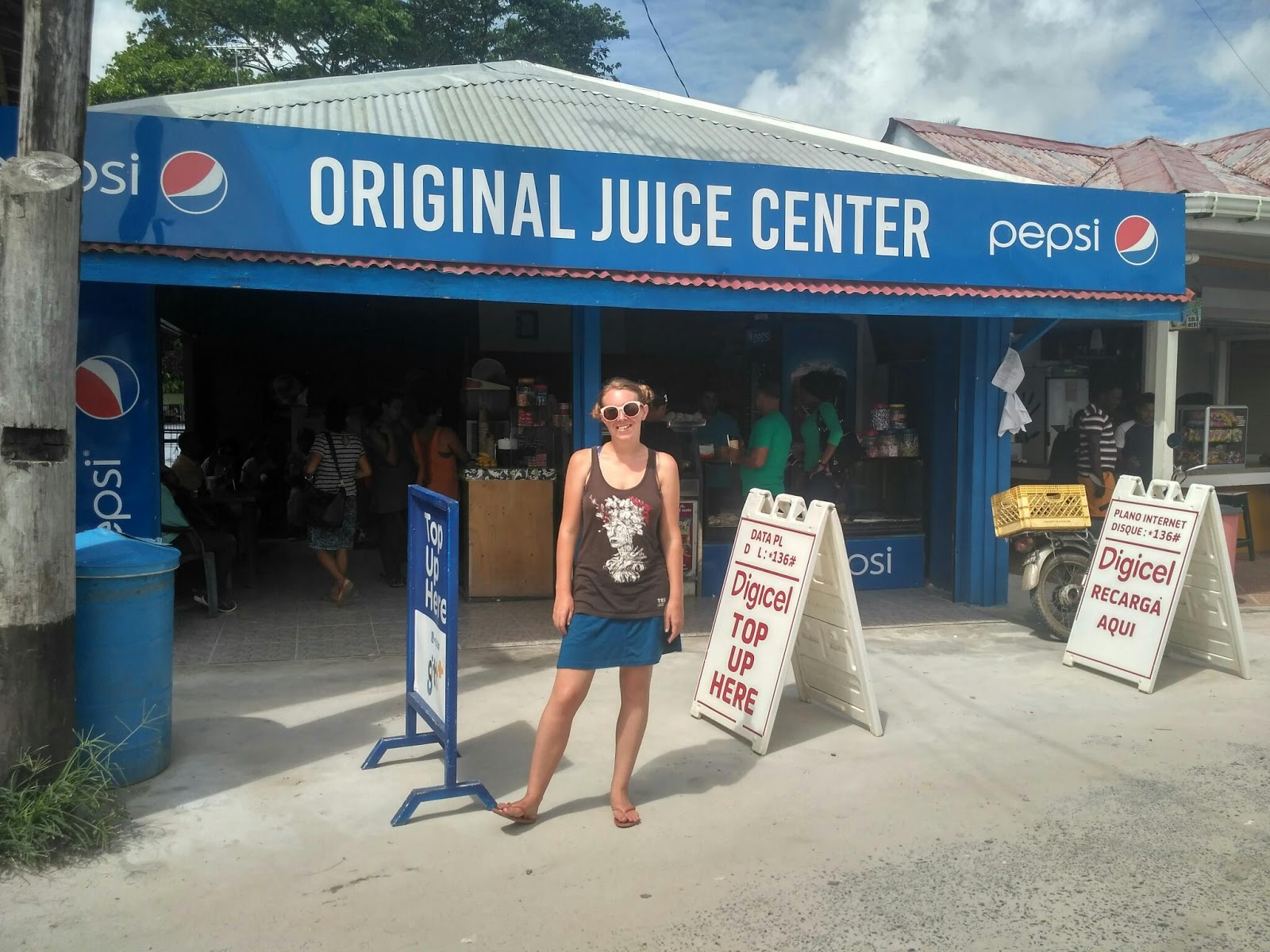
Nevertheless, by 09:30 it was in full swing and the busy streets hardly seemed to belong to the same dusty, almost deserted town we'd seen the previous day. We had breakfast at the market, then a couple of juices at the Original Juice Centre (Sarah had passionfruit, while I decided to give Fruit Punch a try. Too often code for "random red sugary stuff," this fruit punch was delicious with lots f guava, a bit of banana and clearly several other contributors that I couldn't identify).
We'd decided to catch the 13:00 ferry back to Parika. Our departure at 10:30 was a mixed blessing. We missed out on the liveliest part of market day, which focuses on beer, rum and the hotel bars. But we also missed out on the rowdiest, loudest part of market day, which focuses on beer, rum and the hotel bars. Apparently there was a bit of a dispute between the hotels and the local magistrate's court a couple of blocks away, who had decreed that music couldn't be played until the once-a-week court sessions were complete so as no to disrupt them (yes, the music was that loud).
The return journey put us back at Stabroek around 16:30. It was getting a bit late, but frankly we felt like we'd had about enough of the city and decided to carry on east towards our next destination, the border with Suriname.
There were no minibuses left headed to the border town, but we found one going about halfway to Rossignol on the Berbice River. It was only about 95km, so with the recklessly fast driving of most Guyanese minibus drivers we'd be there just shortly after sunset, right?
Wrong. The traffic getting out of town was bad and the coastal road east of G'Town was a bit narrower and rougher than that to the west. When it was 18:45 and fully dark and we still weren't there I began to get (only slightly) nervous.
We didn't know if there would be anywhere to stay in Rossignol and had been hoping to get across the river to the larger town of Nieuw Amsterdam. Well, absolute worst case we could go to the police station and ask to hang our hammocks up outside.
As it turned out we had no reason to worry. When we got near and our bus driver asked where we wanted to be dropped off we told him we were looking for a place to spend the night. He neatly dropped us next to a local minibus heading up the road and across the bridge to Nieuw Amsterdam. That driver in turn helpfully dropped us between what he said were the two best cheap hotels in town. All through Guyana, we'd been pleasantly surprised by taxi and minibus drivers. They seemed to stick scrupulously to the government regulated fares for their routes, varying from them only in occasionally offering a small discount. And they were almost always helpful and knowledgeable as well.
We spent a restful, if slightly expensive night in Nieuw Amsterdam. Guyana is not a cheap place to travel. Food and drink aren't bad, but outside of the interior where you can often find a place to hang up a hammock for next to nothing, accommodation often costs NZD50-60 per night for a basic double room. And ground transportation isn't cheap either, with the ~300km bus ride from Linden to Lethem costing around NZD110 per person (though it is, admittedly, pretty hard on the vehicles). More than once I'd wondered how the Guyanese, whose wages aren't particularly high, managed the elevated prices for even local, non-imported goods.
All that said, Guayana was still a wonderfully pretty and welcoming place to travel. We got more evidence of this the following morning when, after a couple hours drive we arrived in the border town of Skeldon. People in the market were immensely helpful, changing small amounts of US currency to Guyanese dollars, recommending breakfast spots and offering to call us a taxi to the border.
Michael our taxi drive exemplified the welcoming spirit of the people we'd met. "Aw man, you should've come here a few days ago! I could've taken you to the beach, we could've gone to my house for some real Indian food with my family... But I'm glad you've had such a good time in Guyana. Here's the ferry dock now. Yeah, getting a bus on the other side will be no problem. Just 50 Suriname dollars. Just go in through that entrance to buy your tickets and do the customs stuff. Have a good trip!"
What an appropriate and friendly farewell from a friendly and beautiful country!